
Cartoon Art Styles – Why to Pick them For Your Game Project?
Let’s be honest for a second — there’s something timeless about cartoons. Whether it’s the bold lines of Adventure Time, the painterly worlds of Cuphead, or the exaggerated expressiveness of Looney Tunes, cartoon art styles have a magic that never fades. They can be goofy or sophisticated, nostalgic or avant-garde — sometimes all at once.
But here’s the real question: why do these styles continue to thrive in an era obsessed with hyperrealism and 3D perfection? Let’s dig into what makes them tick, and why artists, animators, and gamers keep coming back to this playful, yet deeply expressive form.
Expert note: Style is a storytelling tool, not a filter. Lock your visual language early (shape language, line weight, palette, motion grammar) and keep it consistent across boards, layouts, and animation. Test readability at small sizes and in grayscale before polishing.
The Heartbeat of Cartoon Art Styles
At their core, cartoon art styles are about exaggeration and emotion. The proportions, colors, and motion don’t aim to mimic reality — they aim to amplify it. Big eyes, squash-and-stretch movement, surreal backgrounds — all of it serves a single purpose: to tell a story through feeling, not physics.
And maybe that’s the secret sauce of modern and retro cartoon styles. You can take a stick figure or a blob with eyes, and if it feels alive — if its motion rhythm syncs with emotion — people connect. It’s like jazz for the eyes: the beauty lies in distortion, not perfection. Cartoon art styles strip away the unnecessary, leaving room for imagination.
A Quick Tour Through Time: From Sketches to Screens
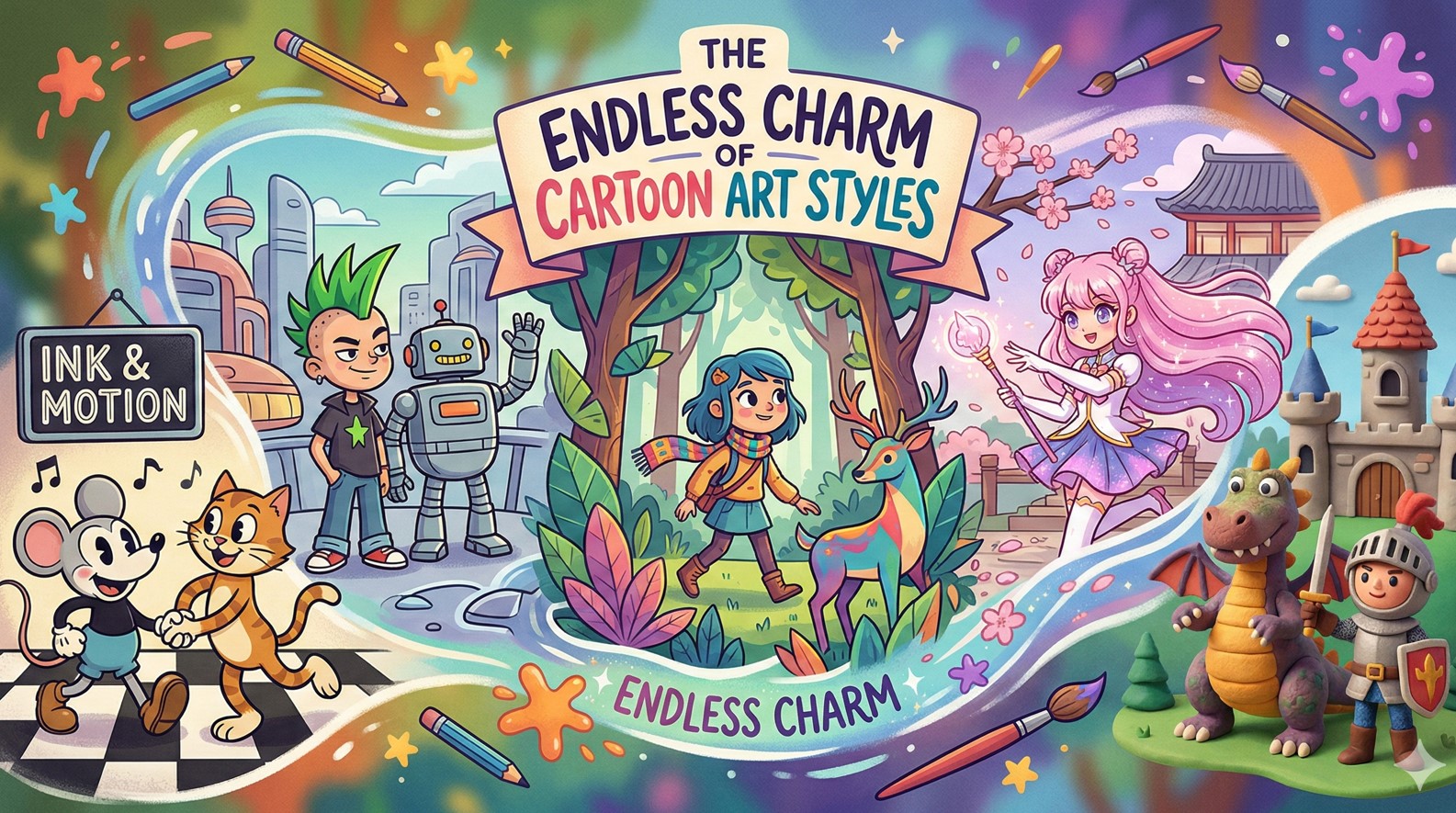
Cartoon art has roots long before animation. Political caricatures in the 19th century were early examples of the exaggeration that would evolve into modern cartoon language. Then came Walt Disney, Max Fleischer, and Tex Avery — turning still sketches into movement, personality, and rhythm.
- 1930s–50s: The golden age — bold shapes, clean outlines, hand-inked cells.
- 1980s–90s: Saturday morning TV dominance; neon palettes, maximalist storytelling.
- 2000s–now: Digital and hybrid techniques — blending 2D charm with 3D rendering.
The evolution of cartoon art styles mirrors culture: from post-war optimism to experimental chaos to internet-age irony. Each era adds its own layer of weirdness and wonder.
| Style Family | Core Traits | Emotional/Mood Signal | Iconic Examples |
|---|---|---|---|
| Minimalist Flat | Simple shapes, thin lines, big negative space | Quirky, warm, character-first | Adventure Time, Steven Universe |
| Rubber-Hose / Vintage | Bendy limbs, looping cycles, grain & halftone | Chaotic, musical, slapstick | Cuphead, early Disney/Fleischer |
| Graphic Angular | Hard silhouettes, sharp shadows, limited palette | Focused, powerful, cinematic | Samurai Jack, Genndy-style designs |
| Loose Sketchy | Visible construction lines, jitter, rough inking | Unpredictable, comedic, meta | Rick and Morty, indie web-toons |
| Painterly / Cel-Shaded Hybrid | Hand-painted BGs, cel-shaded chars, soft light | Nostalgic, storybook, atmospheric | Arcane (hybrid), modern 2D/3D mixes |
The Psychology Behind the Toons
There’s science behind why our brains love cartoon visuals. Simplified shapes are easier to process, freeing attention for emotional cues. Cartoons hit a symbolic sweet spot: abstract enough for us to project feelings, but intentional enough to feel designed. Nostalgia amplifies this effect — familiar exaggerations recall comfort and creative freedom.
Style Is the Message
Each cartoon art style speaks its own visual language. You can often read tone from a silhouette: line weight, color temperature, and spacing communicate faster than dialogue.
- Minimalist flat signals quirky humor and heart.
- Rubber-hose retro evokes vintage chaos and slapstick charm.
- Graphic angular conveys precision, power, and mood.
- Loose sketchy underlines absurdity and spontaneity.
Every stroke is storytelling.
Tools of the Trade
Today’s artists mix workflows: Procreate, Toon Boom, Adobe Animate, Blender, Clip Studio Paint — each with its own strengths. Many pipelines still start with hand-drawn boards, then vectorize, color, and composite. Imperfections are often added on purpose (brush jitter, grain) to humanize digital work.
Where Cartoon Art Meets Gaming
Games lean on cartoon art styles to escape realism fatigue. Stylized titles like The Legend of Zelda: The Wind Waker, Hades, Cuphead, and Don’t Starve are memorable because of visual identity — not polygon counts.
- Lighter rendering load vs. realism.
- Longer shelf life — cartoons age gracefully.
- Freedom for exaggeration, emotion, and surreal mechanics.
| Stage | Focus | Common Pitfalls | Quick Fixes |
|---|---|---|---|
| Style Bible | Shape language, line weight, palette rules | Over-design; palette sprawl | Cap colors (5–7); test silhouettes at 10% size |
| Boards/Layouts | Clear staging, readable silhouettes | Busy frames; unclear focal point | One idea per shot; push contrast & scale |
| Animation | Squash/stretch, on-model posing, arcs | Inconsistent anatomy; floaty timing | Timing chart; hold beats; track arcs |
| Color & Lighting | Story-driven palette; simple light rigs | Color chaos; mood mismatch | Palette per sequence; grayscale check first |
| Final Polish | Line consistency, grain, sound design | Too clean; lifeless audio | Subtle jitter/grain; foley to sell emotion |
Common Missteps in Cartoon Art Design
Even great artists slip up. Watch for:
- Over-designing — detail fights clarity.
- Color chaos — palette should serve story.
- Inconsistent anatomy — stretch/squash needs rules.
- Ignoring silhouette — readable shapes beat surface detail.
The best cartoon art styles maintain internal logic: bend the world, keep the rhythm believable.
The Future: Bold Lines and Boundless Imagination
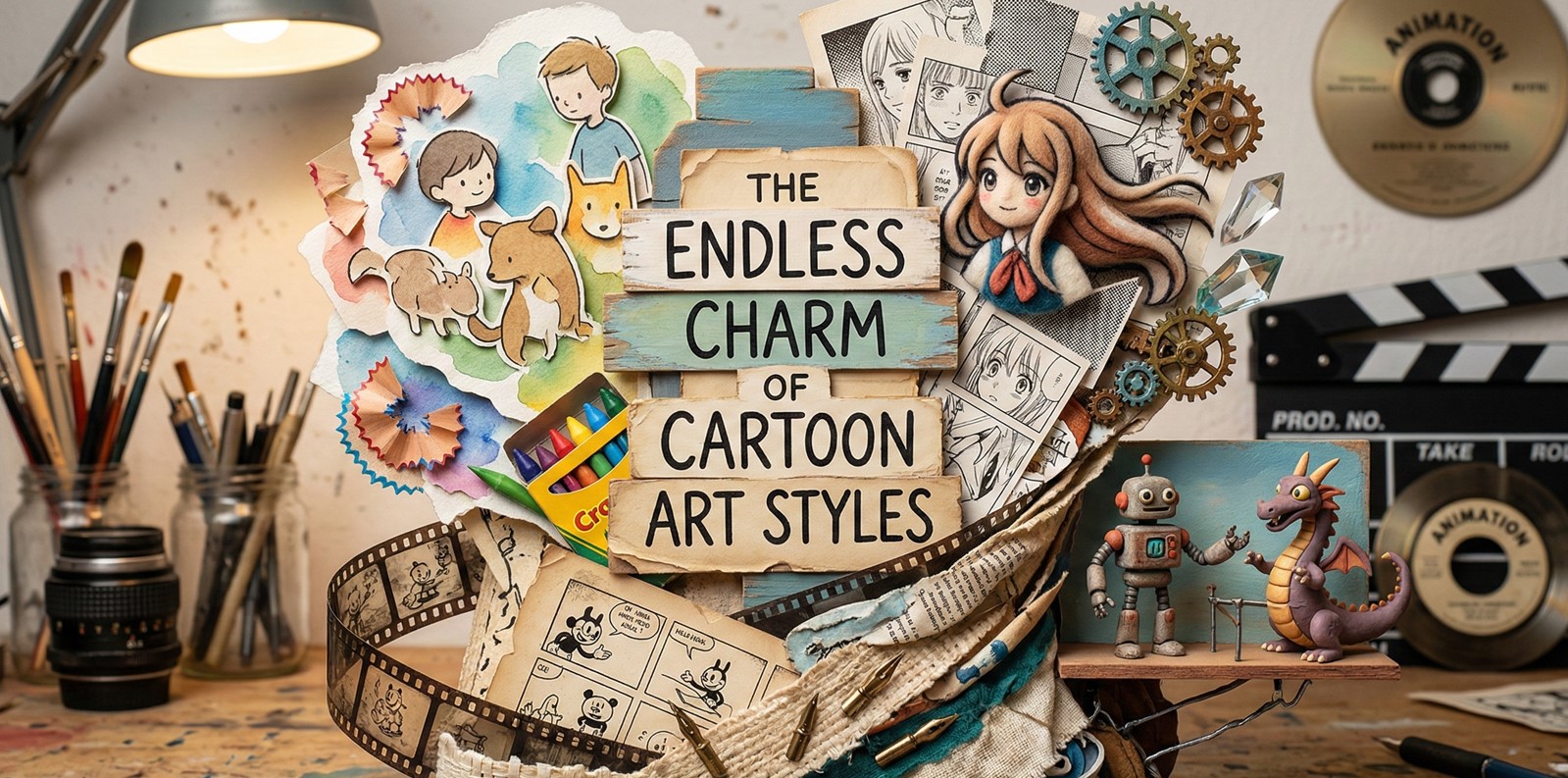
Cartoon aesthetics in video games are thriving across industries — from indie YouTube films to AAA games adopting stylized visuals.
- AI-assisted inbetweening for speed with human-guided keys.
- Hybrid 2D/3D pipelines where lighting/physics amplify flat design.
- Interactive cartoons—style that responds to player/viewer input.
We’re entering an era where style is the hook — audiences want to feel the artist’s hand again.
Final Thoughts
So why do cartoon art styles still captivate us? Because art doesn’t need to be realistic to be real. One exaggerated frame can tell a deeper truth than a lifelike render ever could. In the end, cartoons are about honesty — not how things look, but how they feel. And honestly? That’s why we’ll never outgrow them.