
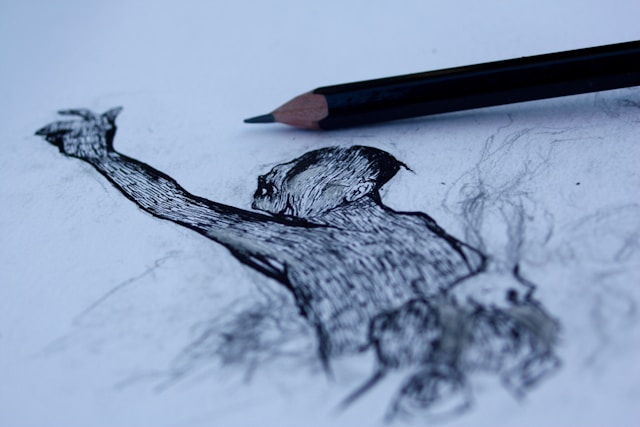
Every animator, whether beginner or master, eventually faces one truth — without solid drawing, animation collapses. You can have great timing, expressive poses, or clever motion arcs, but if your drawings lack structure, they’ll fall flat. Literally.
So what exactly is “solid drawing”? It’s one of Disney’s legendary 12 Principles of Animation — the invisible backbone behind every believable movement. Let’s unpack what it means, why it matters, and how it shapes both 2D and 3D animation today.
Expert note: Solid drawing isn’t about realism — it’s about structure. Study anatomy, perspective, and volume daily. Whether sketching in Procreate or posing in Maya, think in 3D, not 2D outlines.
What Is Solid Drawing?
In simple terms, solid drawing means drawing forms that feel three-dimensional — as if you could pick them up, turn them around, and still recognize them. It’s not about fancy shading or detail; it’s about understanding the weight, volume, and balance of shapes in space.
Think of a character’s arm not as a line, but as a cylinder that turns. Think of a face not as an outline, but as a mass that can tilt and stretch. The idea is to make your drawings live in space, not just sit on a flat screen.
Solid drawing bridges art and physics — it’s how illusion becomes motion.
The Origins: A Lesson from the Masters
When Disney’s “Nine Old Men” coined the 12 principles, they weren’t teaching style — they were teaching life. Solid drawing was their reminder that animation isn’t about lines, it’s about form.
In classics like Pinocchio or The Jungle Book, every character moves as if sculpted from clay. There’s rhythm in their weight, tension in their poses, and logic in their motion. That’s solid drawing in action — invisible, but essential.
Why Solid Drawing Still Matters in Digital Animation
Some people think this principle belongs only to hand-drawn animation. Not true. Even in 3D, the concept lives on. When animators block out poses in Maya or Blender, they’re essentially doing solid drawing — thinking in form, volume, and silhouette.
- The body must have balance.
- The weight must feel real.
- The forms must rotate correctly in perspective.
That’s solid drawing — the foundation that separates amateur work from professional-grade animation.
Key Components of Solid Drawing
So, how do you achieve it? Here are the pillars every animator (or artist) should practice:
- Perspective Awareness — Understand how forms turn in space. Even simple shapes should look consistent when rotated.
- Line of Action — A single curve or line that defines energy and movement. It makes drawings dynamic rather than stiff.
- Weight and Balance — Ask yourself: could this character stand, lean, or jump without toppling over?
- Anatomy and Volume — You don’t need to be a biologist, but you should know how muscles and bones affect shape.
- Silhouette Clarity — The pose should read instantly — even in shadow.
| Component | Creates the Feeling of | Use In |
|---|---|---|
| Perspective | Depth and believability | Camera rotation, turning poses |
| Line of Action | Energy and direction | Dynamic gestures, action poses |
| Weight | Physical realism | Lifting, jumping, landing |
| Volume | Mass and solidity | Character body design |
| Silhouette | Clarity and readability | Staging and posing |
How to Train Your Eye for Solid Drawing
Practice is everything, but not all practice is equal. To improve your solid drawing, focus on exercises that sharpen your spatial intuition:
- Draw through the form. Don’t stop at outlines. Sketch hidden lines and overlapping shapes to understand depth.
- Gesture first, structure second. Capture energy, then add volume.
- Use 3D references. Study real models or objects. Observe how light wraps around form.
- Flip your canvas often. Seeing your work mirrored reveals imbalances and distortion.
- Animate rough spheres. Even a bouncing ball teaches weight and spacing — the foundation of solid form.
Solid Drawing Beyond Characters
Solid drawing isn’t just for figures. It applies to props, environments, and even effects. A falling rock, a gust of smoke, or a car in motion all need structure. Without it, the illusion breaks.
That’s why great animators think like sculptors. They build worlds with believable mass and motion — no matter how stylized.
Common Mistakes to Avoid
Even experienced artists can lose form under pressure. Here are some traps to watch for:
- Flat posing. When limbs align too neatly, movement feels rigid.
- Broken joints. Overbending elbows or knees breaks believability.
- Uneven perspective. If a head and body follow different angles, depth collapses.
- Ignoring gravity. Characters that float when they shouldn’t instantly look fake.
Modern Tools That Support Solid Drawing
Technology has made it easier than ever to apply these principles:
- Procreate / Krita — for quick sketching with 3D guides.
- Blender’s Grease Pencil — lets you draw in 3D space and test perspective live.
- Toon Boom Harmony — integrates onion-skinning and rotation tools to maintain form.
- Maya Ghosting Tools — visualize arcs and poses over time, reinforcing solidity.
| Pipeline | Tool Examples | Common Pitfalls | Quick Fixes |
|---|---|---|---|
| 2D Animation | Procreate, Toon Boom Harmony, Krita | Flat poses, drifting volume, inconsistent perspective | Draw-through practice, flipping canvas, consistent horizon |
| 3D Animation | Maya, Blender, ZBrush | Rigid poses, unnatural balance, camera distortion | Use silhouettes, check from multiple angles, rebalance center of mass |
Why Solid Drawing Is the Soul of Believability
Think about your favorite animated scene — maybe Simba’s first roar or a small lamp hopping across the Pixar logo. What makes those moments work isn’t just timing or design. It’s the illusion that those beings exist.
That illusion comes from solid drawing — the invisible hand that anchors imagination in reality. When you master it, your art stops being “a drawing” and starts becoming “a performance.”
Final Thoughts
Solid drawing isn’t a rule — it’s a discipline. It’s not about drawing perfectly, but drawing truthfully. Once you understand the logic of form and space, everything else in animation — timing, arcs, appeal — falls into place naturally.
So next time you sketch, don’t just draw lines. Build shapes. Feel the weight. Twist the form. That’s where animation stops being technical — and starts being alive.