
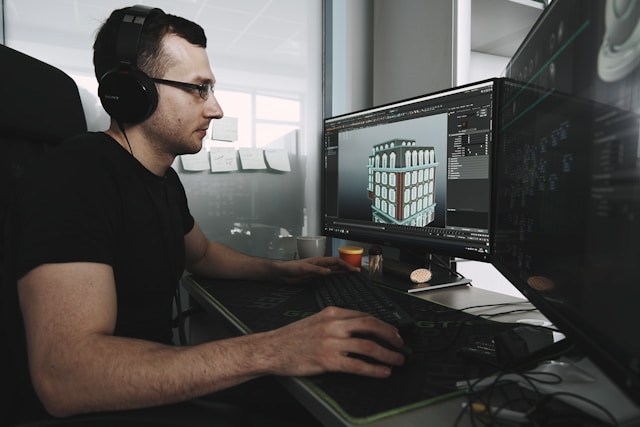
3D Modeling Jobs Help to Build Video Games… Literally!
Something is mesmerizing about watching a 3D model come to life — one vertex at a time. A blank digital space slowly transforms into something tangible: a creature, a product, a building, a whole world. That’s the beauty of 3D modeling jobs — they sit right at the intersection of art, technology, and imagination.
Whether you’re dreaming of working in film, gaming, architecture, or product design, 3D modeling is one of the most versatile and future-proof creative careers out there. But it’s not all shiny renders and high-end workstations. Let’s take an honest, inside look at what these jobs really involve — and why they’re worth it.
Expert note: Hiring criteria vary by industry. Film/game studios prioritize topology discipline, UVs, and pipeline fluency; product/arch viz emphasize accuracy and material realism. Tailor your portfolio to the role you want.
What Are 3D Modeling Jobs?
At their core, 3D modeling jobs revolve around creating digital representations of real or imagined objects using software like Blender, Maya, ZBrush, or 3ds Max. Modelers build the foundation that everything else in a project relies on — the geometry that later gets textured, animated, and rendered into a final product.
But it’s not just technical skill. It’s visual intelligence. A 3D artist needs to understand anatomy, light, physics, and emotion. You’re not just shaping polygons — you’re shaping how people feel when they see your work. In gaming, those forms define character identity. In architecture, they help clients “walk” through unbuilt spaces. In film, they make fantasy worlds believable.
The Growing Demand for 3D Artists
The industry is booming. The rise of streaming platforms, gaming studios, AR/VR, and virtual production has created a surge in 3D modeling jobs worldwide. Every new creative medium — from metaverse environments to digital fashion — needs someone behind the scenes sculpting its foundation.
Even industries far outside entertainment are catching up: real estate firms visualize buildings before construction; medical companies model human anatomy for simulation; retailers use 3D renders instead of photoshoots. Being a 3D artist today isn’t niche — it’s a digital craft with global demand.
| Role/Industry | Primary Deliverables | What Studios Look For |
|---|---|---|
| Film & Animation | Creatures, props, environments, hard/soft surface assets | Clean topology, high-to-low baking, displacement/UDIMs |
| Video Games | Real-time assets, characters, modular kits, trimsheets | Optimization, texel density, PBR workflow, engine setup |
| Arch/Interior Viz | Accurate spaces, furniture, materials, lighting comps | Scale fidelity, photoreal materials, camera/lens sense |
| Product/Industrial | Prototypes, CMF studies, exploded views, turntables | CAD interoperability, precision, material correctness |
| Advertising/Branding | Hero visuals, motion loops, stylized assets | Look-dev flair, speed, concept translation |
Where You Can Work as a 3D Modeler?
Your skills can take you into multiple fields, each with its own flavor: Film & Animation (creatures, props, worlds), Video Games (characters and assets that define player experience), Architecture & Interior Viz (blueprints into photoreal tours), Product Design (virtual prototypes), Advertising & Branding (eye-catching campaign visuals), and Metaverse/VR (interactive spaces that need an artist’s touch). If it exists — or could exist — it probably needs a 3D model.
The Skills Every Modeler Needs
Being great at 3D modeling jobs isn’t just about software mastery. It’s a blend of art and logic — the right and left brain constantly collaborating. Here’s what sets strong 3D artists apart:
- Form & proportion: Sculpture fundamentals, even in digital space.
- Attention to detail: Micro-imperfections make renders believable.
- Topology & optimization: Clean geometry enables animation and real-time use.
- Lighting & shading sense: Material/light interaction defines realism.
- Storytelling instinct: Even static objects should feel purposeful.
- Adaptability: Tools evolve; workflows change — keep learning.
Tools of the Trade
Every modeler finds a toolkit: Blender (free, powerful), Maya & 3ds Max (film/game pipelines), ZBrush (sculpting gold standard), Cinema 4D (motion design). Surround them with Substance 3D Painter for texturing, Marvelous Designer for cloth, and engines like Unreal for real-time look-dev.
| Tool | Best For | Portfolio Wins |
|---|---|---|
| Blender | All-round modeling, grease pencil, Eevee/Cycles | Clean mesh turntables, procedural setups |
| Maya / 3ds Max | Studio pipelines, rig-friendly topology | Deformation tests, pipeline-ready assets |
| ZBrush | High-poly sculpting, organic detail | Sculpt → retopo → bake breakdowns |
| Substance 3D Painter | PBR texturing, smart masks | PBR maps, texel density callouts, look-dev sheets |
| Unreal Engine | Real-time rendering, lighting, LODs | In-engine shots, Nanite/Lumen scenes |
The Creative Process: From Concept to Render
A 3D modeling job typically follows this loop:
- Concepting: Gather references and visual targets.
- Blocking: Define silhouette, scale, proportion.
- Modeling: Build clean, purposeful geometry.
- Texturing: Materials and maps for realism or style.
- Lighting & Rendering: Present your work with intention.
It’s technical, but deeply personal. Each artist brings their own rhythm and taste.
The Challenge Behind the Art
Here’s the part people don’t often mention: 3D modeling takes patience. Hours can vanish refining a single edge or curve that no one but you will notice. Deadlines are tight. Renders crash. Hardware overheats. But when it finally clicks — when your creation comes alive under the right light — it’s pure satisfaction. You made something from nothing, and it feels real.
The Future of 3D Modeling Jobs
AI, real-time rendering, and procedural design are changing the landscape fast. They’re not replacing artists — they’re amplifying them. AI can handle repetitive geometry; real-time makes iteration faster. The future 3D artist is part designer, part technologist, part storyteller — and demand for that blend is rising.
How to Start Your Career?
- Daily reps: Make one small model a day. Consistency beats complexity.
- Study breakdowns: Watch behind-the-scenes from major studios.
- Portfolio first: Publish on ArtStation/Sketchfab with clean turntables.
- Master foundations: Topology, UVs, materials, lighting before FX.
- Join communities: Blender Artists, CGSociety, r/3Dmodeling — seek feedback.
Every great modeler starts as a beginner. The trick is persistence.
Why It’s Worth It?
3D modeling is a career for those who love detail, patience, and seeing the invisible become visible. It’s one of the few jobs where art and technology truly hold hands — where you can design something that exists only because you imagined it.
It’s not always glamorous, but it’s deeply rewarding. And whether you’re freelancing from a laptop or working at a studio shaping the next big game, you’ll know this: you’re part of the creative engine that builds the visual world around us.
Because everything begins with a model — and someone brave enough to build it.