
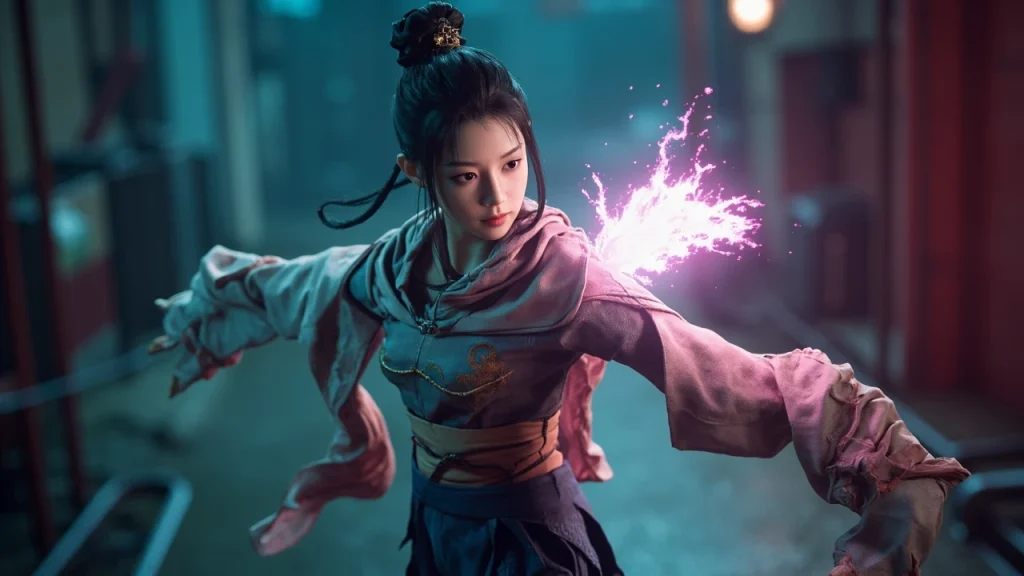
Rumi demon hunters: a GameDev read on a cinematic 3D character
A solo performer is one of the hardest things a character team has to sell. The audience is staring at one face, one silhouette, one idle, and one walk cycle for an entire sequence, so every joint, every costume seam, and every line of dialogue has to do real work. The lead of Netflix’s animated feature KPop Demon Hunters, a half-human singer named Rumi who co-leads a three-person group that secretly hunts demons, sits in that uncomfortable spotlight. For a game developer or technical artist reading the film as a reference, Rumi is a useful case study in how to design a hero whose performative stage presence and combat design share the same skeleton, the same cloth, and the same silhouette without collapsing into a single visual idea.
This article treats the character as a GameDev object: a rigged, animated, voiced, and lit asset that has to read on a phone, a laptop, and a living-room television, while also carrying a story about inherited trauma, family pressure, and the cost of being on stage. The goal is not to summarise the film’s plot or to act as a player guide, since the title is a non-interactive animation, but to break down the production choices that make a character like Rumi work on a pipeline and to show where the same ideas translate to a real-time engine.
What kind of project is KPop Demon Hunters, and why does that matter for Rumi
Before unpacking the character, it helps to set the project type. KPop Demon Hunters is a 72-minute animated feature released on Netflix in 2025, co-directed by Maggie Kang and Chris Appelhans, with animation by Sony Pictures Imageworks. The film mixes K-pop performance, supernatural action, and high school drama, and the cast includes Arden Cho as Rumi, May Hong as Mira, and Ji-young Yoo as Zoey. A reader coming to the title from a game background will notice three production facts that change how Rumi had to be built.
- It is a feature, not a series. The character has to be legible at a distance for the first ten minutes, and identifiable in a crowd for the remaining hour.
- It is musical. Roughly a third of the runtime involves on-screen performance, which means the rig has to survive singing, dancing, and acrobatic staging on the same body.
- It is action-driven. Rumi fights with a demon-magical sword, uses a stage sash as a grappling prop, and performs in arenas with thousands of background characters, so the assets have to read at multiple scales.
Those constraints are similar to the constraints on a third-person action game protagonist. The difference is that a game has to let the player steer Rumi through those states, and that single addition forces a separate set of design decisions around input, camera, and state machine, which the section on combat design below will get to.
The visual design of Rumi: silhouette, palette, and the “dual” hook
Rumi’s silhouette is the first thing a production team has to lock, because it is the part of the character the audience reads fastest and forgets last. The design uses three layers that any technical artist will recognise.
- Base silhouette: an athletic, slightly tall frame with a long ponytail that ends below the hip. The ponytail is doing a lot of the work, because it gives the eye a vertical anchor and lets the animators sell movement through a single strand of geometry.
- Surface silhouette: a fitted stage outfit with strong cuffs, an asymmetric belt, and a long scarf that reads as a separate physics object. Each of these props has a clear edge, which is what allows them to stand out under stage lighting rather than disappearing into the body.
- Effect silhouette: a translucent, geometric pattern that follows the right arm and shoulder. This is the demonic side of the character made visible, and it gives the rig an extra channel for emotion, since the pattern can pulse, fracture, or heal during performance.
The palette is split between a cool indigo for the performance wardrobe and a hot magenta for the demon motif, with warm skin tones in between. That contrast is what makes the character legible in a dark fight scene and a bright stage scene without a costume change. For a game, the same trick is used on characters such as Bayonetta, whose darker base wardrobe pushes the brighter magical effects forward, and on Kiriko in Overwatch 2, whose fox motif gives the rig a separate visual channel during ults.
Anatomy and proportion choices
Drawing Rumi at feature-film quality means choosing where to exaggerate. The art direction leans toward a stylised semi-realism: large eyes, a defined jaw, and long limbs, but with realistic weight and realistic cloth. The animators do not push squash and stretch on the face the way a fully stylised feature such as Spider-Man: Into the Spider-Verse does, but they do push silhouette breaks on the body, especially during the dance numbers. For a game, that ratio is exactly what you want from a protagonist who has to carry both cinematic cutscenes and gameplay camera angles, because the stylised features sell performance while the realistic body sells contact and impact.
Rigging, cloth, and hair: the real-time engine cost of a “simple” ponytail
A long ponytail is the first thing a gameplay programmer will flag when a Rumi-style character enters production. Hair, more than any other system, decides whether a hero can be shipped on a mid-range GPU.
Sony Pictures Imageworks handled the feature on an offline pipeline, where a full hair simulation can take hours per shot. A game team targeting 60 frames per second has to decide whether the ponytail is a fixed joint chain with baked dynamics, a small strip of real-time cloth with a limited number of segments, or a fully simulated groom. The first option is cheapest and is what most third-person action games ship; the second is what you see in titles such as Final Fantasy VII Remake, where Tifa’s hair is heavy enough to feel like a costume but light enough to fit a 60 fps target; the third is reserved for hero trailers and cinematics because the cost does not amortise across gameplay.
Rumi’s long sash is a second, separate cloth object with its own physics. In an offline pipeline it is a stand-alone sim that the animators can retarget and blend into shots. In a real-time engine it is usually a vertex-blend cloth with self-collision disabled and a small number of solver iterations, which is enough to sell the swing without melting the frame budget. The trade-off is that the cloth cannot react to the character’s own arms unless the team hand-codes a per-collision response, which is a known shortcut on outfits that are mostly ornamental.
Performance budgeting for a hero of this type
| System | Common offline choice | Real-time equivalent | Frame-cost direction |
|---|---|---|---|
| Hair | Full strand groom, 30k+ curves | Card-based strands or joint chain | High to low |
| Costume cloth | Per-garment solver | Vertex-blend cloth, no self-collision | High to medium |
| Skin shading | Subsurface and fine pores | Two-layer skin with a simplified SSS term | Medium to medium |
| Eye area | Wet sclera, lash cards, layered iris | Two-plane eye with parallax highlight | Medium to low |
| Demon motif | Procedural shader with painted maps | Single material with mask-driven emission | Medium to low |
The pattern is consistent: the offline pipeline spends time to make each system look finished in isolation, and the real-time pipeline flattens each system to a single material or a single solver so that the sum still fits a frame budget. Rumi’s design has the advantage of giving the engine team an obvious channel, the demon motif, where they can afford the most expensive shader, because that part of the character is also the part that has to read at long distance.
Animation: how the same body sells a song, a fight, and a quiet scene
Rumi is unusual among animated leads because the same rig has to perform three different motion languages without breaking the character. The dance numbers use full-body motion capture with hand-keyed facial performance. The fight scenes use a hybrid of mocap and procedural cleanup, because the demon sword has a real hit reaction that mocap alone cannot sell. The quiet scenes use minimal body mocap and heavy facial work, because the story is about pressure that the character does not want to show on stage.
For a game team, that breakdown is a useful reminder that an action-protagonist rig has to support three independent motion registers at once: a “stage” register that is choreographic, a “fight” register that is reactive, and a “talk” register that is small. A rig that only supports the fight register, as in many mid-budget action games, produces a hero who is convincing in combat but looks stiff during dialogue; a rig that only supports the stage register produces the opposite problem.
State machine thinking for an action character
The way the film cuts between registers is a useful way to think about a real-time state machine. Each performance state has its own entry condition, its own dominant motion source, and its own exit transition, and the registers do not all blend with each other.
| State | Entry condition | Dominant motion source | Allowed transition |
|---|---|---|---|
| Idle on stage | Group is in a performance, Rumi is not in a beat | Looping dance loop, layered ad-lib clips | To “lead vocal” on cue |
| Lead vocal | Rumi is on the lyric line | Hand-keyed facial plus body cleanup | To “fight” on hit, to “idle” on bar end |
| Combat | A demon has aggroed the group | Mocap base with procedural weapon layer | To “vulnerability” on demon reveal |
| Vulnerability | Rumi is hit during a demon reveal | Reduced motion, dropped shoulders, lowered head | To “fight” on resolve, to “quiet” on retreat |
| Quiet | Rumi is off-stage with a single partner | Minimal body, heavy facial | To any other state via explicit trigger |
The interesting line is between “lead vocal” and “fight.” In the film, the transition is a hard cut, because the editor is in control. In a game, that transition has to be triggered by an enemy spawn or a scripted beat, and the rig has to know which animation to interrupt without snapping. The cleanest way to handle it is to mark the “lead vocal” loop as interruptible by combat, but only at the end of a musical bar, so the audience’s reading of the performance is preserved.
Combat design: what an interactive Rumi would actually feel like
The film does not give the audience a full system spec for Rumi’s combat, but the on-screen behaviour is consistent enough to read as an intended design. The clearest way to translate that to a game is to treat the demon sword as a heavy, slow weapon with a long reach, the sash as a medium-range, low-damage utility tool, and the demon motif as a finisher resource that the player has to build up over a song.
A practical interactive version of the character would probably sit in the same niche as a Bayonetta or a Devil May Cry 5 Dante, but tuned for a less experienced player. The weapon timing, the resource loop, and the camera work are all designed to read at medium distance, which is also where most third-person action games are designed to be played.
Designing the move set around three verbs
- Strike. Heavy sword attacks that read as committed animations, with a long recovery window that the player can cancel into a block or a dodge. This matches the on-screen behaviour, where Rumi’s sword swings are exaggerated and visibly take a full beat to recover from.
- Reel. Sash throws that pull demons closer or move Rumi through the air. This is the only movement tool in the kit, which keeps the air game readable.
- Reveal. Demon-motif finishers that the player charges by performing in front of an audience of defeated demons. This ties the performance game to the combat game, which is the part of the film that is most distinctive.
The trade-off in that kit is the dash, or rather the lack of one. Because the sash is the only movement tool, the camera has to do the work of showing where Rumi is going next, and the level designer has to lay out arenas with clear sightlines. If the team gave Rumi a traditional dodge, the sash would feel redundant, and the on-screen choreography would lose the part that makes it look like a stage show.
Storytelling on a hero: how Rumi carries the film without monologuing
Rumi is interesting as a character study because she is not the loudest person in the room, and the film does not give her long monologues. The audience has to read her through three channels: how she sings, how she fights, and how she fails at both. The production design supports that read by making the demon motif a visible, on-screen indicator of how close Rumi is to a breaking point. The pattern darkens, fractures, or spreads when she is under pressure, and heals when she is in a stable relationship with her group. For a game, that is a useful pattern, because it gives the engine a state to drive shaders, audio mix, and enemy aggression without forcing a UI element on the screen.
The voice direction also leans on a quiet register. Arden Cho underplays the dialogue scenes and lets the singing scenes do the heavy emotional work, which is why the singing scenes feel earned. A game version of Rumi would not have the same luxury, since most player-facing dialogue is voiced in shorter windows. The fix is to move the emotional beat into the singing scenes, where the player can hear the performance at full length, and to use the dialogue scenes for setup only.
Level, set, and audio: how a Rumi stage is built
The film uses three recurring set types: the high school, the group’s apartment, and the demon-hunting arenas. The arenas are the most useful to study because they have to support a performance and a fight at the same time, and the audience has to be able to read both. The way the film handles that is to give each arena a clear “stage” surface, a clear “back” surface, and a clear “house” surface, where the back is where the demons enter, the stage is where the group performs, and the house is where the audience stands.
For a game, that translates to a set of constraints that any level designer would recognise: the stage has to be readable from a fixed camera, the back has to be readable from a combat camera, and the house has to be readable from both. The cleanest way to do that is to force the player to choose a camera orientation at the start of an arena and to keep that orientation for the duration of the fight, which is also how the film cuts between the two views.
Audio as a level system
The film’s audio is built around the idea that the group can only fight when the music is on. In a game, that becomes a powerful resource system: the player has a song meter that ticks down during a fight, and the meter is the only thing keeping the demons at bay. When the meter is empty, the demons push in; when the meter is full, the player can perform a finisher. The design works because the audio mix is the most visible part of the system, since the player can hear the music thinning and thickening as the meter moves. For a developer, that is a good template for any resource system that has to be readable in a fast fight, because audio cues survive screen clutter better than UI elements do.
How a Rumi-style hero would be scoped in a real production
It is worth sketching what a real production that built a Rumi-style hero would look like, because the scope of a character like this is the part that most often goes wrong. The first question a producer has to answer is the platform target, because the platform decides which of the systems above can ship at full quality. A console or PC build can afford the full hair and the full cloth; a mid-range mobile build has to cut one or both. The second question is the camera model. A third-person action camera supports the silhouette and the fight register, but it makes the facial performance harder to read. A 2.5D camera, as in a side-scrolling action game, makes the silhouette and the stage register easy to read, but it makes the fight register harder to stage. The third question is the audio budget, which is the part of the production that most often gets cut before the visuals do.
| Decision | Lower-budget answer | Higher-budget answer | Visible effect on Rumi |
|---|---|---|---|
| Platform target | Mobile, mid-range GPU | Console, high-end PC | Hair and cloth resolution |
| Camera model | 2.5D side view | Third-person orbital | Silhouette readability, facial performance |
| Audio budget | One or two original songs, looped | Full album with stems and reactive mix | How often the resource system can reset |
| Animation source | Hand-keyed loops plus IK | Mocap base with cleanup pass | Dance and fight quality |
| Facial rig | Two-channel with a few blendshapes | Full FACS with audio-driven lipsync | How much the audience reads emotion |
A team that is honest about the platform and the camera can save months of rework later, because the rig, the cloth, and the audio system all have to be designed around the worst case, not the best case.
Lessons a game team can take from the character
The Rumi case study is a useful way to revisit a set of GameDev habits that often go unexamined, because the film is built around exactly the same constraints a game has to manage. Five points are worth restating.
- Lock the silhouette before the rig. The shape of the character is the part the audience reads first, and it is the part that the rig has to support for the rest of the production.
- Treat performance and combat as one rig, not two. Two separate rigs cost more to maintain and produce a hero who feels like two characters in one body.
- Give the engine one expensive shader channel. A single high-quality effect, such as the demon motif, gives the technical artist a place to spend the budget without melting the frame.
- Make the audio mix a level system. Audio is the most reliable cue in a fast fight, and the resource system should be visible in the mix, not just in the UI.
- Scope for the worst case. The rig, the cloth, and the audio system have to be designed for the lowest-spec target on the platform list, or the project will need a rebuild before launch.
Each of those points is a small change to a familiar pipeline, but together they are the difference between a hero who reads as a character and a hero who reads as a stack of assets.
Where a Rumi-style character would not work
It is also worth being honest about the cases where a Rumi-style character would not be the right answer. A first-person shooter does not need a long ponytail or a sash, because the audience never sees them, and the cost of simulating them shows up in the frame budget without showing up on the screen. A four-player co-op game, where the camera has to keep four bodies in view at once, has to make each character simpler than Rumi, because the screen real estate is divided four ways. A competitive multiplayer game has to keep each character readable against a background of other players, which is a different problem from reading a single character against a stage.
The right way to use the Rumi case study is to ask which of the systems above is doing real work in a given project. If the answer is “none of them,” the character should be simplified until the systems are doing real work, because a stack of expensive systems that the audience cannot see is the most expensive waste in real-time production.
Frequently asked questions
Who is Rumi in KPop Demon Hunters?
Rumi is the lead of the trio in the 2025 Netflix animated feature KPop Demon Hunters. She is a half-human, half-demon singer who co-leads a K-pop group that hunts demons between performances. She is voiced by Arden Cho, and the production is a 72-minute animated film rather than a game, so the article treats her as a design reference rather than a playable character.
Is KPop Demon Hunters a game?
No. The title is a feature-length animated film produced by Sony Pictures Imageworks and released on Netflix in 2025. There is no shipped game under the same name as of the article’s writing date, and the article’s GameDev framing is therefore about character, animation, and combat design as production references, not about an in-game build.
What kind of weapon does Rumi use?
On screen, Rumi fights with a demon-magical sword that is slow to swing and long to recover from, and she uses a stage sash as a grappling and movement tool. In a game, that combination is best modelled as a heavy, committed melee weapon plus a single utility movement ability, which keeps the kit readable in a third-person action camera.
How would a game version of Rumi control?
A practical interactive version would use a three-verb kit: a heavy strike, a sash-based reel for movement, and a charged demon-motif finisher that the player builds by performing in front of an audience of defeated demons. The camera should stay third-person and the level arenas should have a clear stage, a clear back, and a clear house, so the performance and the fight read at the same time.
What is the hardest part of building a character like Rumi in a real-time engine?
The hair and the cloth are the most expensive systems on the rig, and a mid-range GPU cannot afford a full strand groom and a per-garment cloth solver at the same time. The standard answer is to ship a card-based or joint-chain hair with a vertex-blend cloth, and to spend the freed budget on a single high-quality shader channel such as the demon motif, which is also the part of the character that has to read at long distance.
Why does Rumi’s demon motif matter for a game design?
The demon motif is the on-screen indicator of how close Rumi is to a breaking point, and it is the part of the character that does the most work for the least amount of screen real estate. In a game, that channel can drive a shader, an audio mix, and an enemy aggression curve without forcing a UI element on the screen, which is a useful pattern for any hero whose story is about pressure.
Who voices Rumi?
Rumi is voiced by Arden Cho, who has discussed the role in interviews around the film’s release. The casting is part of why the character’s quiet dialogue scenes land, and it is a useful reminder for a game team that voice direction and character design have to be planned together rather than handed off in sequence.
What engine would suit a Rumi-style game?
Any modern third-person action engine with a cloth solver, a strand or card hair system, and a node-based audio mixer is enough to build a Rumi-style hero, and the choice of engine is less important than the choice of platform target. The platform target decides which of the systems above ship at full quality, and that decision is the one the producer has to make first.
What is the most useful lesson from the Rumi case study?
The most useful lesson is that a hero’s performance rig, combat rig, and dialogue rig should be one rig, not three, because two separate rigs cost more to maintain and produce a hero who feels like two characters in one body. Designing the three registers on a single skeleton is what lets a Rumi-style character read as a single person on stage, in a fight, and in a quiet scene.
Where can I read more about the production of the film?
The For additional context, KPop Demon Hunters entry on Wikipedia is a useful starting point for the production history, and a Times of India interview with Arden Cho about the role gives useful detail on the voice direction. Both are best read as production references, not as reviews, and neither replaces a careful study of the film itself.