
Fast and Furious 11: what game developers and designers can actually learn from the franchise
Fast and Furious 11 sits in a strange place for a working game team. It is a live-action feature in a series famous for car chases, but the mechanics that make the films feel distinctive are the same mechanics a racing or action game has to engineer from scratch: the rhythm of a set-piece, the way a vehicle feels at speed, the rules a franchise uses to keep its world coherent across sequels, and the production math that decides whether a licensed mode, a stunt, or a live event is worth shipping. A development lead reading about the next film is not really reading about cinema. They are reading about a long-running IP that has spent two decades testing what survives contact with an audience and what does not.
This article treats Fast and Furious 11 as a case study for game production, vehicle handling design, cinematics in an interactive medium, IP licensing trade-offs, and the engineering of live events such as arena shows. The goal is not to chase the film’s release schedule. It is to extract repeatable lessons: how the source material earns its spectacle, what a designer can borrow, what a producer should refuse, and where the franchise model collides with the realities of running a real-time simulation at sixty frames a second. Where the franchise’s own history matters, the relevant context from the broader Fast & Furious film series is used as primary evidence, not as decoration.
Readers who only want a film release summary will not find it here. The audience is the developer, technical artist, or producer who has to decide whether their next racing feature, action open world, or licensed event should engage with this IP at all, and if it does, what they have to build to keep the result honest.
The production shape of Fast and Furious 11 and why it matters to studios
Every major feature in the Fast and Furious line is itself a production case study, because the series has spent more than twenty years refining a very specific formula. The original 2001 film was a street-racing crime picture. Each sequel widened the world: heists in foreign cities, a submarine heist, a tank, a plane sequence, and eventually a literal space launch. The franchise kept the same core cast and a recognizable vehicle aesthetic while escalating the scale of every set piece. That history is the right starting point, because the decisions a game team has to make about set-piece design, vehicle roster, and player fantasy are not new. The series has already tested them with hundreds of millions of paying viewers.
For a game team, three production patterns stand out. First, the series treats spectacle as a designed output, not a happy accident. The car launch, the heist, the chase through a city street are scripted the way a studio scripts a boss fight: the build-up, the mid-point reversal, the payoff, and the recovery beat. Second, the team has protected a small number of franchise rules across every entry, including the family theme, the modified-car visual language, and the line between cartoon physics and grounding. Third, the series has been willing to kill expensive toys. Sequences that worked once and would feel repetitive have been retired rather than repeated, which is a hard discipline for any franchise holder, including a games publisher.
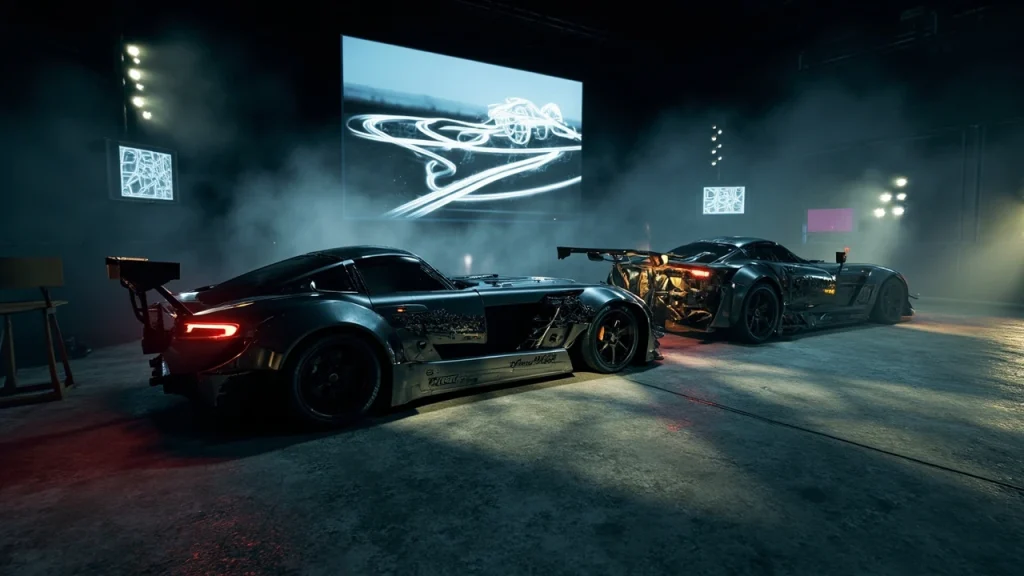
The For additional context, producer-led gamble behind the long-running Fast and Furious live show shows the same logic in a different medium: the team was willing to commit twenty-five million pounds and years of work to a single arena experience because the brand could carry that scale. The lesson for a game studio is that IP value is real, but it has to be matched by a production plan that can survive contact with the real world.
What the series actually is, in production terms
In production terms, the franchise is a serialized action property with a slowly expanding universe. Each entry is built around a small number of high-cost set-pieces, a returning ensemble, a refreshed vehicle roster, and a marketing hook tied to a familiar visual trope. The team has, over the years, treated the films less as standalone stories and more as seasons of a long-running show. That framing matters to a game team because a long-running live-service game has to make the same trade-offs: a small set of expensive flagship moments, a cast players recognize, and a visual language the audience can identify at a glance.
Set-piece design and the rhythm of an interactive chase
The single most useful transferable skill in the franchise is set-piece construction. A Fast and Furious film is built from roughly three to five major sequences that carry the marketing weight, with shorter connective tissue between them. Each major sequence follows a recognizable internal rhythm. The team introduces the goal, raises the stakes with a complication, lets the characters improvise inside a partly closed system, and resolves the sequence on a designed payoff. The audience is rarely lost, because the structure carries them.
That is also how a good racing or action game chapter should be built. A designer who treats a Fast and Furious film as a storyboard is doing the same exercise a level designer does when they lay out a chase through an industrial zone, a harbour, or a city block. The interactive medium adds one constraint the film does not have: the player has to be able to fail and recover without breaking the spectacle. That is the hard part, and it is where most licensed racing games struggle.
The four-beat structure the franchise uses
Almost every set-piece in the series follows four beats. The first beat is the setup: the team is shown the problem, the equipment, and the constraint. The second beat is the attempt: a plan is executed, but a complication forces an improvisation. The third beat is the inversion: the audience is shown the scale of the problem in a way that turns the plan on its head. The fourth beat is the resolution: the team commits to a final, often expensive solution that pays off the previous three beats.
A racing game chapter can be built on the same beats. The setup is the briefing and the vehicle selection screen. The attempt is the opening section of the track or city route, where the player learns the tools. The inversion is the scripted event that the player could not have planned for, such as a collapsing bridge or an opponent ambush. The resolution is the final stretch where the player uses the tools they have learned in a high-stakes run. The difference is that the film can cut, while the game has to keep the player inside the simulation and let them fail safely.
What fails when the four-beat structure is copied poorly
Copying the surface of a set-piece without copying the structure produces a scripted sequence the player has to watch rather than play. That is the single most common failure of licensed chase games. The team records a cinematic in which a famous actor drives a famous car through a famous location, drops the player into a short interactive window in the middle, and then returns to the cinematic. The result feels like a movie with a loading screen in the middle of every action beat.
The structural fix is to design the chapter so that the player’s choices change which of the four beats dominates. A high-skill player might pass the setup quickly and meet the inversion early; a low-skill player might be forced through the full attempt before the resolution becomes available. Either way, the player is acting inside the structure rather than watching it. This is also why the franchise’s mid-film heists work: the team is improvising, and the audience can see that the plan has gone wrong even if the outcome is predetermined.
Vehicle handling design: the franchise’s hidden language
Vehicle handling is the most visible design decision in any racing game, and the franchise’s visual language is a good starting point. The series uses three recognizable vehicle archetypes, and each one carries a specific narrative weight. The tuned import, the muscle car, and the heavy-duty truck each map to a different kind of character and a different kind of scene. A designer who picks a vehicle roster at random loses that mapping; a designer who picks vehicles by character role keeps the franchise’s visual grammar intact.
The deeper question is what those vehicles feel like. The film series leans into a specific physical fiction. Cars are heavy, but they corner as if their mass is being redirected by the driver’s commitment. Launches feel like an event, with the camera shaking and the suspension compressing. Crashes feel consequential. The franchise has never tried to be a simulator, but it has also never tried to be an arcade toy. It sits in a band of physical fiction that is closer to a tightly tuned action game than to a simcade racing title.
Handling archetypes worth defining for a racing project
The following table summarizes the three handling archetypes a designer can derive from the franchise’s visual grammar. The values are illustrative ranges, not published targets from any shipping game, and they are meant as a starting point for design discussion rather than a recipe.
| Archetype | Franchise example | Narrative role | Target top speed | Steering response | Weight transfer feel |
|---|---|---|---|---|---|
| Tuned import | Mid-2000s Japanese coupe | Younger team member, precision runs | High | Sharp, low lag | Quick rotation, light rear |
| Muscle car | Late-1960s American coupe | Veteran, raw power | High peak, lower average | Loose at limit, recoverable | Strong rear squat, long recovery |
| Heavy-duty truck | Modified off-road pickup | Mission specialist, anchor | Moderate | Slow, deliberate | Heavy, with high traction events |
The point of the table is not the numbers. It is that each archetype has a different narrative role, and the handling model has to make that role legible to the player within a few seconds of driving. If a player can swap a tuned import for a heavy truck and the only difference is the cosmetic, the franchise’s grammar is broken.
Where the franchise’s vehicle fiction breaks
There are moments in the films where the physics are openly cartoonish, and the audience accepts them. A car that flies between two skyscrapers, a submarine heist, a literal space launch. The franchise protects those moments by treating them as set-piece peaks rather than the baseline. A game that runs at cartoon physics for the entire experience loses the impact of those peaks because there is no normal level to contrast them against.
This is a hard rule for any licensed racing or action game based on the property. The baseline handling has to feel grounded enough that the set-piece moment feels earned. If the player has been driving on a frictionless surface for the entire game, a set-piece where they drive up a collapsing building does not register as a change in scale. It registers as the same scene they have been in for the last hour.
Cinematics in an interactive medium
The franchise’s signature is the long, unbroken take. The camera follows a chase through a city, inside a building, across a roof, and back out onto the street, and the audience feels the geography because the geography is real. A game that wants to borrow that feeling has to make a serious investment in how it records and plays back cinematic camera motion, and it has to accept that the cost is high.
There are three practical ways to build cinematic chase sequences in an interactive game, and the franchise’s films effectively use all three in different scenes. The first is the in-engine take, where the game records the player’s actual vehicle path and the camera is directed over the top in real time. The second is the hybrid take, where the game records a base run on a track and then lets the player interact at specific decision points. The third is the fully authored take, where the cinematic is rendered offline and the player’s input is restricted to a small range of actions at scripted moments.
Comparing the three approaches
| Approach | Best use case | Production cost | Player agency | Failure mode |
|---|---|---|---|---|
| In-engine take | Replay and community sharing | Medium | High | Camera collisions, visual confusion |
| Hybrid take | Story chapters with set-pieces | High | Medium | Hard cuts that break continuity |
| Fully authored take | Key franchise moments | Very high | Low | Player feels like a passenger |
Each approach has a place. The in-engine take is the workhorse for replay value, because it produces a camera path the player can re-enter. The hybrid take is the right answer for a story chapter with a defined climax. The fully authored take should be reserved for the two or three moments a chapter cannot live without, because the cost in time and art effort is significant and the player can feel the loss of agency.
Why long takes are hard in real time
The single most common reason a long take fails in a game is occlusion. The film franchise can position a camera on a wire or a stabilized rig, control every prop in the background, and edit out the moment a building covers the line of sight. A real-time engine has to keep the camera collision working, the vehicle collision working, the prop collision working, and the level of detail budget under control, all at the same time. If the team has not budgeted for it, the take will break the first time the player drives into a covered area.
The fix is to design the level for the camera first and the player second. A chase route that the camera cannot follow is a chase route that cannot be presented as a long take. This is also why the franchise’s real locations, including Havana, Tokyo, and Tbilisi, are not just backdrops. They are camera paths. A game team that treats the city as decoration will not be able to sustain the long-take feeling for more than a few seconds.
IP licensing and the licensing math a studio should run
Licensing is the part of the franchise most game teams underestimate. A working title cannot just announce a Fast and Furious 11 tie-in. The licensor will have a list of approved vehicles, a list of approved character likenesses, a list of approved phrases, a list of approved locations, a list of approved music, and a list of approved ways to alter the visual identity of the franchise. Every entry on those lists has a cost, and the costs are not equal. Vehicles are usually the cheapest licensed asset. Music is the most expensive. Character likenesses and named locations sit in between.
The right way to budget a licensed project is to start with a list of moments, not a list of assets. For each moment the team wants to ship, the question is which licensed asset the moment needs. If the moment can be built without a licensed asset, the moment is cheap. If the moment requires a specific actor, a specific track, or a specific location, the moment is expensive. The team then ranks the moments by impact and licenses the expensive ones first. Moments that cannot be built within the licensed envelope are cut, not crammed.
Licensing cost tiers, expressed as decision criteria
Licensing is a moving target, and any specific number a team quotes will age out within a year. The useful framing is tiers of decision, not tiers of dollars. A team should treat the following tiers as a checklist during pre-production, not as a price guide.
- Cosmetic tier: the licensed element is a paint, a decal, or a wheel design. The visual identity is unchanged, the player is not asked to confuse the licensed item with a real-world product, and the licensor usually signs off quickly.
- Vehicle tier: the licensed element is a drivable vehicle. The team has to model, rig, damage, and audio-fy the car, and the licensor will want a review of the handling curve, the sound design, and the camera work. This is the most common licensed asset in a racing game and the one most teams have a workflow for.
- Character tier: the licensed element is a likeness, a name, or a phrase. The licensor will want to approve any line of dialogue, any scripted moment, and any marketing use of the character. The team’s writing has to be flexible because licensed dialogue is rewritten during the review cycle.
- Location tier: the licensed element is a named real-world place. The licensor will want to approve the geometry, the signage, and any cultural detail. This tier is often the slowest, because location approvals involve local authorities and on-the-ground research.
- Music tier: the licensed element is a track or a score. This is the most expensive tier per minute of content and the most restrictive, because music rights are typically negotiated per use case rather than per title.
The list is not a budget, but it gives a producer a way to talk to a licensor before the contract is signed. The right question is not “how much does this cost” but “how many moments in our design depend on this tier, and how many of those moments can we protect if the licensor pulls the asset at the last minute.”
Live events, arena shows, and the production of a traveling experience
Fast and Furious 11 sits inside a franchise that has already produced a major arena show, and that history is worth a developer’s attention. A live arena show is the closest non-interactive cousin to a real-time game. The show has to run on a fixed schedule, the audience has to be guided through a sequence of moments, the performers have to stay inside a designed envelope, and the production has to recover from failures without breaking the audience’s belief. The cost of building the show is also closer to a game’s cost than to a film’s cost, because the assets are reused and the audience sees the show many times in a single city.
The relevant production gamble behind the long-running Fast and Furious live show is the clearest available record of how a franchise team budgets a traveling experience. The team committed to a multi-year build, accepted the risk of a single misjudged audience, and protected the brand by refusing to scale the show in ways the franchise’s visual grammar could not support. The lessons are not that a game team should build an arena show. The lessons are that a serialized IP is a long-term investment, that the audience will punish a stretched grammar, and that the production plan has to be honest about which moments are repeatable and which are not.
What a live event teaches a real-time engine team
Three lessons transfer directly. First, the show has a small number of high-cost moments and a large number of low-cost moments, and the audience remembers the high-cost ones. A game should design its season with the same ratio: a few flagship events the team invests in, surrounded by lightweight live ops that keep the population active. Second, the show is run on a fixed schedule and a fixed venue footprint, which is a real-time constraint. A game team that tries to ship a live event with a flexible schedule ends up shipping nothing. The event has to have a start time, an end time, and a defined reward. Third, the show’s failure modes are visible. If a stunt fails, the audience sees it, and the team has a recovery plan. A game event that fails silently is worse than a game event that fails loudly, because the players who notice will spread the news and the players who do not will assume the event is not worth the time.
Narrative, family, and the rules of a long-running IP
The franchise’s narrative rule is simple on the surface and hard to maintain: the team is a family, the family protects its own, and outside pressure has to be answered by escalation rather than retreat. The rule survives because it is flexible. Different films have used the rule in different ways, but the audience can always answer the question “is this story still about family” in the first ten minutes. A licensed game that breaks that rule breaks the franchise.
The same applies to a game’s narrative design. If the team introduces a new playable character, the new character has to fit the family rule or the family rule has to be redefined in front of the audience. A silent protagonist works in some franchises; it would be jarring in this one, because the franchise’s strength is its named ensemble. The team’s job is to keep the ensemble legible, not to bury it under a customizable avatar.
Character roster decisions
- Lead characters: the names the licensor will protect most aggressively, including dialogue, voice, and likeness. Lead characters should be the chapter anchors, not the entire roster.
- Supporting characters: the names the licensor will allow in a smaller range of moments, usually without their own chapter. Supporting characters are the right level for most playable cameos.
- Background characters: the names the licensor will allow in set dressing and crowd scenes. Background characters are useful for the world and cheap to license, because they do not need a name, a voice line, or a written moment.
- Original characters: the team’s own additions, which the licensor will want to review for tone. A well-written original character is the cheapest way to expand the roster, because the license is for the world rather than for the name.
The mistake a studio makes is to build the entire roster out of lead characters. The licensor’s review cycle will not survive it, and the player’s experience will be a string of cameos rather than a story.
QA, certification, and the cost of a franchise-grade vehicle
QA on a licensed racing title is its own discipline, and the franchise’s vehicles are a good test case. A licensed car has to look right, sound right, handle right, and survive a certification review. The four questions are not the same question. A car can pass handling tests and fail certification, because certification checks the visual identity of the licensed asset rather than the engineering quality of the simulation. The team’s QA plan has to mirror the licensor’s review process, not the publisher’s.
A QA checklist for a licensed vehicle
- Visual review: the vehicle matches the licensor’s reference pack at the angles the licensor will check, including the front three-quarter, the side profile, the rear, and the wheel detail.
- Audio review: the engine note, the exhaust, and the tire sound fit the licensor’s reference at idle, cruise, and full throttle.
- Handling review: the vehicle feels like the licensed archetype, with the steering response, weight transfer, and braking behavior the team committed to during pre-production.
- Damage review: the vehicle damage model does not produce an image the licensor will reject, including the shape of the deformation and the persistence of the damage state.
- Certification review: the vehicle passes the platform holder’s certification for content, including any regional restrictions on licensed brand content.
- Regression review: the vehicle still feels right after a patch, a new tire model, or a new track surface. A new physics version can break a vehicle the team has already signed off on, and the QA plan has to re-run the relevant tests.
The checklist is not a one-time exercise. Each vehicle has to be re-checked after every physics change, every art change that affects the silhouette, and every audio change that affects the engine note. A team that runs the checklist once and assumes the result sticks is a team that will discover the regression during certification.
Performance, platform targets, and the cost of spectacle
The franchise’s visual grammar is heavy. The vehicles are detailed, the environments are dense, the set-pieces are built around the long take, and the lighting has to support all of it. A game team that wants to keep the franchise’s look has to plan a performance budget the same way a film team plans a lighting and camera budget. The two are not the same, but they rhyme.
On PC and on the current generation of consoles, the realistic target is to hold a stable frame rate at the resolution the platform’s audience expects, with the lighting model the art direction demands. The set-piece scenes, including the long take, are the scenes that will cost the most. A team that plans the average frame time without planning the worst-case set-piece frame time will discover the problem during a late milestone. The fix is to budget the long-take scene against the worst case, not the average, and to design a fallback for any moment the engine cannot sustain.
Performance budget decisions worth making early
- Resolution and upscaling: the team should pick an internal render resolution, an upscaling path, and a target output resolution per platform before any visual feature is locked. Picking this late forces a rewrite of the lighting model.
- Vehicle polygon budget: the franchise’s vehicles are dense, and the team has to pick a hard ceiling for the high-detail LOD and a separate ceiling for the damage state. The damage state is usually the more expensive of the two, because it has to deform in real time.
- Set-piece budget: the long-take scenes need a separate frame budget from the rest of the game, and the team has to design a graceful fallback. The fallback is not a low frame rate; it is a different camera, a shorter take, or a different route.
- Audio budget: the engine and exhaust sounds have to mix against the music and the dialogue, and the audio team has to plan the mix for the loudest moment of the set-piece, not the average moment. The loudest moment is the one that will fail certification if the dialogue becomes unintelligible.
Accessibility, localization, and the audience the franchise actually serves
Fast and Furious 11 will be released into a global audience, and the franchise’s visual grammar is one of the few that travels well. The cars are recognizable across regions, the music has a strong Latin and hip-hop spine that resonates with the franchise’s core demographic, and the set-pieces are legible without dialogue. A licensed game that ships into the same audience has to plan for the same regional spread, and the localization work has to start during pre-production, not after the English script is locked.
Accessibility is the second axis the franchise has not always handled well in the games space. Vehicle handling is a high-skill activity, and a player with reduced motor control or a player who is new to racing games needs a real on-ramp. The right pattern is the one the best racing games use: an assist layer that does not punish skilled play, a difficulty curve that does not require perfect inputs, and a rewind that does not break the score. A licensed racing game that ships without an assist layer is a licensed racing game that ships to a smaller audience than the franchise actually has.
Localization decisions worth making before writing begins
- Text length: the UI and the dialogue have to be designed for the longest localized language, not the shortest. A team that locks the English line lengths first has to rewrite the UI when the German or Russian line arrives.
- Lip sync: the cinematic dialogue has to be planned for languages the team can lip sync against, including the languages the licensor will require. A team that records English lip sync and then tries to localize onto it produces a result the audience will not believe.
- Character names: the character roster has to be designed for languages that have to localize the names rather than translate them. A character whose name carries narrative weight in English may carry no weight in another language, and the team’s writing has to anticipate the loss.
- Cultural review: the franchise’s visual grammar includes cultural elements that vary by region. The licensor’s review will be stricter in some regions than in others, and the team’s pre-production has to plan for the strictest case.
Player fantasy, vehicle roster, and the long-tail of a licensed game
The franchise’s player fantasy is older than the films themselves. It is the fantasy of the tuned import, the family garage, and the team that can out-run any rival. A racing game that ships under the franchise’s name has to protect that fantasy, because it is the reason the audience is there. The vehicle roster is the first place the fantasy shows up, and the long-tail of the roster is what keeps the audience engaged after the launch window.
A long-tail roster is a roster that keeps giving the player something new without forcing the team to ship a new vehicle every month. The pattern that works in shipping racing games is a small launch roster, a steady drip of new cars, and a clear set of design reasons for each new car. The design reasons can be a new handling archetype, a new visual subgenre, or a new chapter in the story. The wrong reason is a license the team paid for and has to use, because the audience can tell.
Vehicle roster expansion patterns
| Pattern | Production cost | Audience signal | Risk |
|---|---|---|---|
| Launch roster | Very high | Strong first impression | Hard to update once shipped |
| Story chapter car | Medium | Tied to narrative payoff | Forgotten after the chapter |
| Archetype car | High | Refreshes handling variety | Requires handling rework |
| Visual subgenre car | Medium | Refreshes art variety | Forgotten by non-art-focused players |
| Event car | Low | Drives live ops engagement | Hard to give narrative weight |
The table is not a recipe. The right mix depends on the season the team is planning, the size of the team, and the licensor’s review capacity. The useful takeaway is that each pattern has a different cost and a different audience signal, and the team has to plan the season against the signal it wants.
What to refuse when the license lands
The last lesson is the simplest. A licensed game is the most expensive game a team will ever ship, and the cost is paid in decisions the team has to refuse. The team’s job is to make a list of the decisions it will refuse, before the licensor’s first review, because the review is too late to change course.
The list below is a starting point. A real team will add to it during pre-production.
- Refuse licensed dialogue the team has not written: the licensor will want the team’s writers to deliver a script, and the team should refuse any line the writers did not write. Licensed dialogue that is dropped into the script by a non-writer is licensed dialogue the team will have to defend in QA.
- Refuse licensed vehicles the team cannot damage: a franchise vehicle that cannot take damage breaks the franchise’s grammar, and the team’s QA plan has to include a damage pass for every licensed vehicle. If the licensor refuses a damage model, the vehicle is not in the game.
- Refuse licensed locations the team cannot render at the licensor’s quality bar: a named location that the team cannot render with the licensor’s reference accuracy is a named location the team should not ship. The audience will recognize the gap, and the gap will be the marketing hook for a competitor.
- Refuse licensed music the team cannot mix against the set-piece audio: a track that overpowers the engine note or the dialogue is a track the team cannot use, because the franchise’s audio grammar is part of the visual grammar.
- Refuse timeline pressure that shortens QA: the franchise’s vehicles need a real QA cycle, and a shorter cycle produces a worse game. The team’s job is to defend the cycle, not to ship the title to a date.
The list is uncomfortable. Each item is a moment the team has to say no to a stakeholder, and the cost of saying no is real. The cost of not saying no is also real, and it shows up in the review, the QA cycle, and the player’s first hour with the game.
Frequently asked questions
What is Fast and Furious 11 in production terms?
Fast and Furious 11 is the eleventh mainline feature in the Fast and Furious series, a long-running action franchise built around a recurring ensemble, a tuned-car visual grammar, and a small number of high-cost set-pieces per film. For a game team, the production value of the entry is in its handling of franchise rules, vehicle roster, and the long take rather than in its standalone story.
Why is the franchise interesting to a racing game team?
The franchise has spent more than twenty years testing a specific set-piece rhythm, a specific vehicle grammar, and a specific narrative rule about family. A racing or action game that wants to borrow any of those elements is borrowing a tested pattern, which lowers the design risk and shortens the iteration loop. The franchise’s history is documented well enough that the team does not have to guess what works.
What is the most transferable design pattern from the films?
The four-beat structure of a set-piece: setup, attempt, inversion, and resolution. The pattern is the basis for a chapter in a racing or action game, and it can be used to design a level, a live event, or a marketing hook. The pattern only works when the player is acting inside it, not watching it.
What should a studio refuse when the license lands?
The studio should refuse any licensed asset the team cannot deliver at the licensor’s quality bar, including dialogue, vehicles, locations, music, and the QA cycle itself. The list of refusals is the most important pre-production document, because it protects the team from shipping a licensed product that the licensor will reject or the audience will punish.
How do the franchise’s live events translate to game live ops?
Live events translate well to live ops when the team plans a small number of high-cost flagship moments, a fixed schedule, and a defined reward. The franchise’s arena show is the closest non-interactive cousin to a real-time game, and the same production logic applies: a few expensive peaks, a long tail of low-cost content, and a recovery plan for the moments that fail.
What performance budget decisions matter for a long-take set-piece?
The set-piece scene needs a separate frame budget from the rest of the game, with a graceful fallback. The team should design the worst-case scene first and the average scene second, because the set-piece is the scene that will cost the most, the scene that will fail certification if it stutters, and the scene the player will remember.
How should a team handle accessibility in a licensed racing game?
The team should plan an assist layer that does not punish skilled play, a difficulty curve that does not require perfect inputs, and a rewind that does not break the score. A licensed racing game that ships without an assist layer ships to a smaller audience than the franchise actually has, and the cost of the assist layer is far lower than the cost of the lost audience.
What is the right way to plan a localized licensed game?
Localization has to start during pre-production, with a UI designed for the longest localized language, lip sync planned for the languages the licensor will require, character names planned for languages that localize rather than translate, and a cultural review planned for the strictest region. A team that locks the English script first is a team that will rewrite the UI when the German line arrives.
How do the franchise’s character roles shape a playable roster?
The franchise’s character roles are stratified: lead, supporting, background, and original. A playable roster should be built from a small number of lead characters, a larger number of supporting characters, and a deep pool of original characters that the licensor’s review will pass. A roster built entirely from lead characters will not survive the licensor’s review cycle.
What is the cheapest way to extend a licensed racing game after launch?
The cheapest way to extend a live racing game is the event car, a low-cost, time-limited vehicle that drives engagement during a live-ops window. The event car does not carry narrative weight, but it gives the team a way to ship content without committing to a new archetype, a new chapter, or a new handling rework. The pattern works when the team plans the season around it, and it fails when the team uses it as a substitute for new design.