
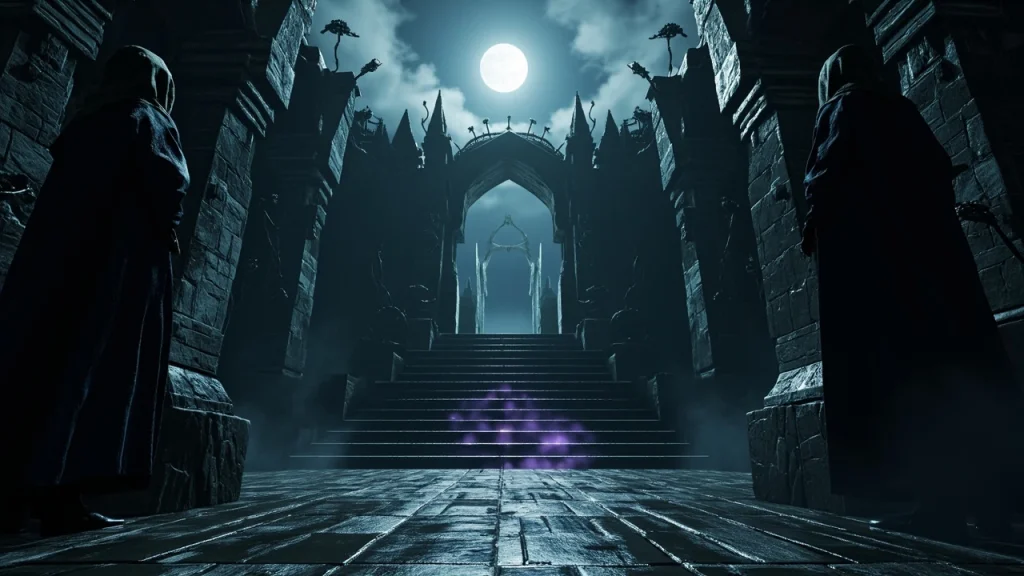
House of grief in Baldur’s Gate 3: what the quest actually is
The House of Grief is a mid-to-late Act 3 location in Baldur’s Gate 3, run by the Dark Urge’s mother and the cleric of Shar Viconia DeVir, who returns as a major figure in the building after her appearance in earlier games. From a player perspective it is the home of the Sharran cult that has kidnapped Dame Aylin, the aasimar tied to Shadowheart’s personal storyline. From a development perspective it is one of the most concentrated narrative and combat spaces in the lower city of Baldur’s Gate: a small map that contains a stealth section, a boss arena, a moral decision, a romance gate, and a branching outcome that rewrites several Act 3 conversations depending on which companions the party brought along and which of the Gauntlet of Shar decisions the player made in Act 2.
This guide treats the House of Grief as a designed game space, not just a side quest. The walkthrough below covers how to start it, how to handle each room, what each choice actually changes, and what the developers at Larian built into the space and why. The goal is to make a first or replay run predictable without removing the decisions that make the encounter interesting for a party that is already invested in the Shadowheart arc.
How to start the House of Grief quest
The House of Grief is unlocked by the quest Find the Nightsong, which is the broader Shar storyline that runs through the Gauntlet of Shar in Act 2 and the lower city in Act 3. After the Nightsong is freed or killed, the player can return to the lower city and look for the building where the Sharran faithful have gathered. The transition is handled by ambient dialogue and a journal entry that updates the moment the party crosses into the lower city districts, so the player does not need to track a hidden trigger.
There are three reliable entry points that show up in most playthroughs.
- Speak to any of the Shar worshippers in the lower city, especially the cloaked figures standing in alleys near the Black Hand assassin base. They reference “the Mother Superior” and point toward the House of Grief without naming it directly.
- Follow the personal quest marker for Shadowheart. Once her Act 2 confrontation about the Nightsong is resolved at the Gauntlet of Shar, the marker updates to guide the party toward the House of Grief during Act 3 and stays active even if the player ignores the lower city for a while.
- Explore the lower city deliberately. The building is south of the Baldur’s Mouth warehouse district and is marked on most city maps once the player gets close enough, with a clear Sharran sigil above the front entrance.
Players who ignored the Gauntlet of Shar in Act 2 can still enter, but several dialogue options and an entire boss mechanic are gated behind Nightsong-related choices. The space is designed for a level 9 to 12 party, which is the typical Act 3 progression when the player reaches the lower city in any order. Trying to enter with a level 7 party is technically possible through the side passage, but the boss will outscale under-leveled casters and the rewards will not carry the party through the final act.
Layout and room flow
The interior is smaller than it looks from the outside. Larian compressed what is essentially a dungeon crawl, a stealth section, and a boss fight into three connected halls so that pacing stays tight. Knowing the layout makes the encounter faster on a second run and helps a party that wants to do a quick split-push instead of clearing the dungeon as a single block.
| Room | Primary activity | Key NPCs | Mechanical notes |
|---|---|---|---|
| Foyer and ritual corridor | Dialogue with Viconia, optional persuasion | Viconia DeVir, cloaked cultists | Establishes Shar’s theological framing and Shadowheart’s personal stakes |
| Inner sanctum and Aylin’s cell | Free or leave Dame Aylin | Dame Aylin, Shadowheart | Multiple dialogue outcomes; affects Aylin’s role in the final act |
| Mother Superior’s audience hall | Boss arena, central decision | Viconia DeVir (boss) | Two waves of adds, environmental hazards, party-wide AoE |
Each room has at least one skill check, and the order in which the party clears them changes which checks are available. Approaching from the front entrance triggers the longest dialogue with Viconia and unlocks a religion check that can end the fight without combat. Entering from the side passage near the Black Hand base triggers a shorter, more hostile version of the same scene, locks out the peaceful resolution, and reduces the dialogue to a single contested roll before the boss script begins.
Combat: how the House of Grief fight actually works
The combat encounter is built around a single boss and two waves of supporting cultists. The arena is a long hall with a raised dais where Viconia stands. The floor has ritual circles that pulse on a fixed timer, dealing necrotic damage to anyone standing inside them and applying a stacking debuff that makes subsequent ticks worse. The pillars at the edges of the room can be used as line-of-sight breaks for ranged characters and as cover for healing during the add wave.
The fight has three mechanical beats.
- Phase one, dialogue pre-roll. The party can attempt persuasion, religion, or intimidation checks to convince Viconia to stand down. A successful religion check from Shadowheart ends the fight without combat, and the quest resolves peacefully. Failing or refusing the check starts the fight, and the dialogue exits as soon as any party member takes a hostile action.
- Phase two, the add wave. Viconia summons two Sharran shadow disciples and a third elite cultist. The shadows have high mobility and teleport behind the front line, so back-line casters need to reposition rather than hold position. A control spell such as Hold Person or a Glyph of Wasting placed on the ritual circle will often decide this phase before the boss lands a real hit.
- Phase three, the Mother’s intervention. Around 50 percent health, Viconia calls on Shar’s chosen, which triggers a script-driven event that either damages the party or, depending on prior choices, summons Dame Aylin as an allied NPC. If Aylin is free and the party has not attacked her, she appears in the doorway and adds a sustained divine damage aura to the boss phase.
The most common first-time failure is treating the fight as a single-target duel. Viconia’s damage output is moderate compared with other Act 3 bosses, but the ritual floor and the teleport shadows create constant positional pressure. A party that focuses her first usually loses at least one character to the floor damage before the add wave is cleared. A party that burns down the shadows, then isolates Viconia near a pillar, generally wins in two rounds and avoids the worst of the necrotic ticks.
Choices and consequences
The House of Grief is built to deliver branching outcomes, but most of those branches reduce to a small number of patterns. The patterns matter because they map directly to the underlying narrative systems Larian designed for Shar worshippers, Shadowheart’s personal quest, and the player-character’s relationship with the goddess. The branching is not as wide as it looks in marketing copy, but the few branches that do exist feed back into the ending cinematics and the epilogue slides.
| Choice | Where it is made | Effect on Shadowheart | Effect on the final act |
|---|---|---|---|
| Kill Viconia after refusing to kneel | Audience hall, post-combat | Resolves her Shar arc, locks in the Selûne ending for her | Aylin is freed, Shadowheart becomes a Selûne cleric in the epilogue |
| Spare Viconia and convert her | Audience hall, religion check | Keeps her in Shar’s path with a crack in her certainty | Causes Viconia to appear as a conflicted figure later; some party members disapprove |
| Betray Shadowheart for Shar | Inner sanctum, with Viconia present | Ends her personal quest on a dark note | Activates the Dark Urge or a custom evil-aligned epilogue branch |
Players who want the cleanest narrative payoff generally pick the first option. Players who want the morally complex version pick the second. The third option exists primarily for the Dark Urge playthrough, where the player character is already on a Shar-aligned path and the House of Grief becomes the place where that alignment is confirmed publicly. The third path also changes how the epilogue slides treat the player character, which is the main reason it is interesting beyond pure shock value.
Stealth and alternative paths
The House of Grief is one of the few Act 3 locations that can be partially completed without fighting. The side entrance near the Black Hand base opens into a servant corridor that runs behind the main hall. A stealth-oriented party can pick off the patrolling cultists, free Aylin without alerting Viconia, and trigger a shorter version of the boss fight. The stealth path also gives the party a way to scout the boss arena before committing to a position, which is useful on a Tactician or Honour Mode run.
Two practical stealth rules hold up across parties.
- Cultists patrol in fixed patterns, but the patrol routes are not synchronized. Splitting the party to clear two routes at once is faster than working as a single group and saves a round of combat. Each cleared route also reduces the number of cultists that spawn during the boss fight.
- Aylin’s cell has a separate perception check. A thief or a character with high Sleight of Hand can open the lock silently, but failing the check raises an alert that forces the rest of the dungeon to spawn. Bring a backup with high Sleight of Hand if the primary opener is unreliable.
Stealth is not a free win. Even with every cultist killed quietly, Viconia’s script still triggers the audience hall fight. The benefit of stealth is resource economy, not skipping the encounter. Parties that go in expecting to bypass the boss will be surprised by the scripted cutscene that pulls the player into combat regardless of how cleanly the dungeon was cleared.
Loot and rewards worth the visit
The House of Grief has a small but high-value loot table, which is consistent with how Larian designs late-game side content: fewer items, but each one addresses a specific build or story beat. A party that runs the dungeon primarily for the loot will not be disappointed, but the real value is the named accessories that set up a few builds for the final act at the docks.
| Item | Type | Best user | Why it matters |
|---|---|---|---|
| Darkfire Shortbow | Ranged weapon | Rogues, rangers | Adds Haste on a kill, which is rare for a level 9 bow |
| Amulet of Shar | Accessory | Shadowheart, any cleric of Shar | Boosts necrotic damage and adds a once-per-rest blindness spell |
| Spellguard Shield | Shield | Front-line casters | Grants advantage on saving throws against spells, useful against Act 3 mages |
| Nightsinger’s Guile | Helmet | Stealth parties | Passive advantage on stealth checks inside Shar-related spaces |
Outside of the named drops, the audience hall contains a hidden chest behind the dais that requires a high perception check to find. The chest holds consumable reagents that are useful for the final fight at the Baldur’s Gate docks, so it is worth searching even on a fast run. There is also a small reading desk in the foyer that contains a letter describing the Mother’s long-term plans for the lower city, which is a useful lore drop for players who want to understand the cult’s role in the city-wide plot.
How the House of Grief fits the rest of Act 3
From a level design standpoint, the House of Grief is a narrative bottleneck. Almost every other Act 3 storyline either ignores it or depends on it, which is unusual for a side location. The orphanage storyline runs in parallel and does not require this quest. The Bhaal temple, the murder investigation, the foundry, and the counting house all have their own self-contained arcs. The House of Grief is the only place where a personal companion arc and a city-wide faction arc converge in a single room with a single resolution.
That convergence is why the location is mandatory for players who want to see Shadowheart’s epilogue and optional for players who do not bring her. Larian built the space to be skippable, but the cost of skipping it is a closed-off companion storyline rather than a closed-off quest. The fight itself is not the main product; the resolution of Shadowheart’s identity is. The loot table is a secondary reward that gives the party a reason to enter even on a run where the personal arc is not the priority.
Why the order matters
The House of Grief can be cleared before or after most other Act 3 quests, but the order changes what information the party has when they arrive. Clearing the murder tribunal first gives the party evidence about the Dark Urge that affects dialogue with Viconia, because the Mother Superior reacts to the player’s reputation in the lower city. Clearing the foundry first gives the party a political lever that one of the cultists reacts to during the audience scene. Clearing the House of Grief first, on the other hand, is the cleanest narrative order because it lets the player bring the resolved Aylin into the final act as a full companion rather than a cameo.
Players who want the most complete version of the Act 3 story should treat the House of Grief as a mid-Act 3 stop, after the personal companion quests are advanced but before the final act begins. That placement lines up with the level curve Larian tuned for the lower city: roughly level 10 to 11 when entering, level 11 to 12 when leaving. A party that runs the dungeon significantly later will already be at the level cap and will lose the sense of progression that the encounter is designed to deliver.
Common mistakes and how to avoid them
Most failed runs in the House of Grief come from a small set of predictable decisions. Knowing the failure modes ahead of time is more useful than memorizing the boss’s spell list, because the room design punishes the same mistakes on every difficulty. A party that has cleared other Act 3 dungeons will still find that the House of Grief has its own rhythm, and the rhythm is not the same as the Bhaal temple or the foundry.
- Starting the fight from the center of the room. The ritual floor is densest in the center. Move the party to the edges before the boss script triggers, and only then engage. Standing on the side pillars is the safest opening position for a party that has not seen the fight before.
- Ignoring the cultists. They are level-appropriate, but the shadows have a teleport that bypasses frontline tanks. A caster with an AoE control spell should hold an action to interrupt them, especially on Tactician where the teleport cooldown is shorter than on Balanced.
- Forgetting Shadowheart’s dialogue gates. Several checks in this quest are gated on her presence. A party that benches her for combat reasons loses access to the persuasion options that can end the fight without bloodshed and loses the cleaner epilogue slide that follows the Selûne resolution.
- Skipping the perception check on Aylin’s cell. Missing the cell does not break the quest, but it removes the most reliable way to free Aylin without combat, which then forces the harder version of the boss fight and removes Aylin’s allied NPC aura from the audience hall.
Difficulty scaling and difficulty-specific behavior
The encounter scales with the difficulty setting the player chose at the start of the campaign. On Balanced, the fight is roughly on par with other mid-Act 3 bosses and the ritual floor ticks for a moderate amount of necrotic damage. On Tactician, Viconia gains an extra legendary action and the ritual floor damage doubles, which means the side-pillar position becomes a hard requirement rather than a preference. On Honour Mode, the cultist wave adds a fourth enemy and the boss’s AoE spell is upgraded to hit the entire room, including the area behind the pillars.
Players running Honour Mode should treat the House of Grief as a high-risk node, not a side quest. The room does not have a checkpoint inside it, and a total party wipe sends the player back to the lower city entrance. The recommended loadout is at least one healer, one front-line tank with shield proficiency, and one AoE caster. A second healer is safer. Bringing a character with a source of cold damage is also worth considering, because the ritual circles interact with cold spells in a way that can clear the floor temporarily during a tight round.
Design notes: how the space was built to teach
The House of Grief uses a fairly compact design pattern that Larian uses throughout Act 3: a small number of rooms, a heavy narrative payload, and a single combat arena that is reused for multiple outcomes. The architectural language is the same as other Shar-related spaces in the game, with curved stone, ritual circles, and a clear vertical axis that the player descends into. Larian repeats that vocabulary so the player can recognize a Shar space at a glance, which is the kind of environmental storytelling the studio leans on heavily in both Act 2 and Act 3.
The two stealth checkpoints and the side entrance are part of a deliberate design choice. The lower city has many entry points, and the team wanted at least one major Act 3 location to have a stealth path that does not bypass the boss. The result is a space that rewards exploration without making combat optional. Players who want to fight can fight from the front. Players who want to be clever can clear the dungeon quietly and still face the boss with full mechanics intact, which keeps the encounter honest while still giving the player agency over the run.
The narrative layering is the strongest part of the design. Viconia is a returning character from earlier Baldur’s Gate games, and the space is set up to either honor or contradict that history depending on the player’s choices. The Dame Aylin rescue is a separate thread that becomes a direct counter to Viconia when both are alive in the same room. That combination is rare: a single fight that resolves two storylines without reducing either one to a flag check. The design budget for the encounter is small, but the budget is spent on the things that matter most for the player’s experience.
House of Grief on a replay: speedrun-friendly checklist
For players running a second or third campaign, the House of Grief compresses into a predictable sequence. The following list is the cleanest route for a Balanced-difficulty party that wants the Selûne ending for Shadowheart and a full companion slot for Aylin in the final act. The same route works on Tactician with minor adjustments to the opening position and the order in which the add wave is cleared.
- Enter from the front, accept the dialogue with Viconia, and refuse to kneel. This keeps the long dialogue path open and prevents the side-passage hostile variant from triggering.
- Pass the religion check with Shadowheart to attempt a peaceful resolution. If it fails, proceed to combat and skip the dialogue tree to save time.
- Use the side passage to free Dame Aylin before the boss fight, which gives the party an allied NPC for the audience hall and unlocks the Aylin companion scene later in the act.
- Trigger the audience hall fight from the front, drag the party to the pillars, and burn the shadow adds before focusing Viconia. Save the AoE control spells for the teleport phase, not the opening round.
- After the fight, choose the dialogue option that confirms Shadowheart’s break with Shar and recruit Aylin for the final act. This is the option that locks the Selûne epilogue slide.
The full run takes about 25 minutes on a second playthrough with a prepared party. It is one of the more efficient Act 3 locations, which is part of why it is a popular choice for players who want a single, complete Shadowheart arc in a focused play session. Speedrunners can compress the run further by skipping the perception check on the foyer reading desk and heading straight for the audience hall, but most players will want the lore drop on the first visit.
Frequently asked questions
Do I have to do the House of Grief quest in Baldur’s Gate 3?
No. The quest is optional, but it is the only place where Shadowheart’s Act 3 personal storyline reaches a resolution. Players who want her full epilogue should complete it. Players who do not bring Shadowheart can still enter for the loot, but most of the dialogue options will be locked and the audience hall fight will default to a hostile version with no peaceful resolution path.
What level should my party be for the House of Grief?
Level 9 is the soft minimum and level 12 is a comfortable cap. Most parties that reach the lower city through normal exploration are level 10 or 11 when they find the building, which is the intended range. Parties below level 9 will struggle with the add wave and the ritual floor damage, and parties above level 12 will find the encounter trivial even on Tactician.
Can you save Dame Aylin in the House of Grief?
Yes. Aylin is locked in a cell inside the dungeon. Freeing her before the boss fight is the most reliable way to have her appear as an ally during the audience hall combat and during the final act. The cell can be opened with a Sleight of Hand check, a key carried by one of the cultists, or by killing the cultist who holds the key during the stealth section.
Does killing Viconia lock you out of any content?
Killing Viconia ends the peaceful resolution branch, but it does not lock the player out of any major questline. The only content it removes is the option to convert her to a non-Shar path, which is a niche outcome most players do not pursue. The loot table and the audience hall dialogue are identical regardless of which option is chosen.
Is there a way to skip the House of Grief boss fight?
There is no way to skip the boss entirely, but a successful religion check with Shadowheart resolves the fight through dialogue. A failed check still ends the fight, but the audience hall combat sequence is replaced by a single contested roll that determines whether the cultists stand down or join the fight as a smaller add wave. The boss still needs to be dealt with, but the fight is shorter.
What happens if Shadowheart is not in the party?
The quest still triggers, but several dialogue gates close. Viconia speaks to the party in a more hostile tone, and the peaceful resolution option is unavailable. Combat is the only outcome, and the loot table is the same. Shadowheart’s personal quest will close without a final scene, and her epilogue slide will use the default version rather than the Selûne or Shar-specific variant.
Is the House of Grief the same on every difficulty?
Mechanically, the encounter is the same. The numbers change: Tactician adds a legendary action, and Honour Mode adds a fourth cultist and upgrades Viconia’s AoE. The layout and the dialogue options are identical across difficulties, which is unusual for an Act 3 location and is part of why the encounter works as a design case study.
What is the best loot from the House of Grief?
The Amulet of Shar and the Spellguard Shield are the two items most players take out. The Darkfire Shortbow is the third, and it is the best-in-slot bow for several rogue and ranger builds at this level. The hidden chest behind the dais also contains reagents that are useful for the final fight at the docks, so it is worth the perception check on a first run.
Does the House of Grief quest affect the ending?
Yes, but only if Shadowheart is in the party. Her House of Grief choice sets the tone for her epilogue and decides whether she remains a cleric of Shar or converts to Selûne. The player’s own ending is not changed by the outcome, but the party’s ending slides will reflect the choice through Shadowheart’s presence in the final camp.
Can you enter the House of Grief without finishing Act 2?
No. The building is locked until the Nightsong quest is resolved, and that quest only opens after the Act 2 Shar storyline is complete at the Gauntlet of Shar. Players who try to reach it earlier will find the doors sealed and the lower city fast-travel points will not register the location. The side passage is also gated behind the same flag, so there is no workaround for an early entry.
What the House of Grief says about modern RPG design
The House of Grief is a useful case study because it combines several design patterns that have become standard in contemporary role-playing games: a compact dungeon, a stealth option that does not skip the boss, a layered narrative with two interleaving arcs, and a boss fight that resolves the story rather than gating it. None of these elements are new on their own. What is interesting is the way Larian tied them together in a single location and made the player’s prior Act 2 choices the primary lever that controls the outcome. The encounter is short, but the encounter is dense, and that density is what gives the location its weight in the broader Act 3 structure.
For developers studying the encounter, the key lesson is that a tight design budget can still deliver a high-impact scene when every room in a dungeon carries a specific function. The House of Grief has no filler. Each hallway exists to set up a dialogue, a perception check, or a combat beat, and each of those beats connects to a known quest or character. That is a discipline more than a feature list, and it is the reason the encounter remains memorable even though the fight itself is short compared with other Act 3 bosses. The lesson carries over to smaller projects because the same discipline applies regardless of the size of the team or the length of the campaign.
For a closer look at how grief as a thematic core is handled in narrative writing, the Guardian review of Helen Garner’s This House of Grief offers useful background on the emotional register the title evokes. The For additional context, This House of Grief Wikipedia entry covers the book’s structure, reception, and the courtroom narrative that has informed how writers approach grief as both a subject and a structural device. For related coverage on the site, see the practical breakdown of how dungeon key placement shapes encounter pacing in escape-room level design and the broader look at how video game background art carries narrative weight.