
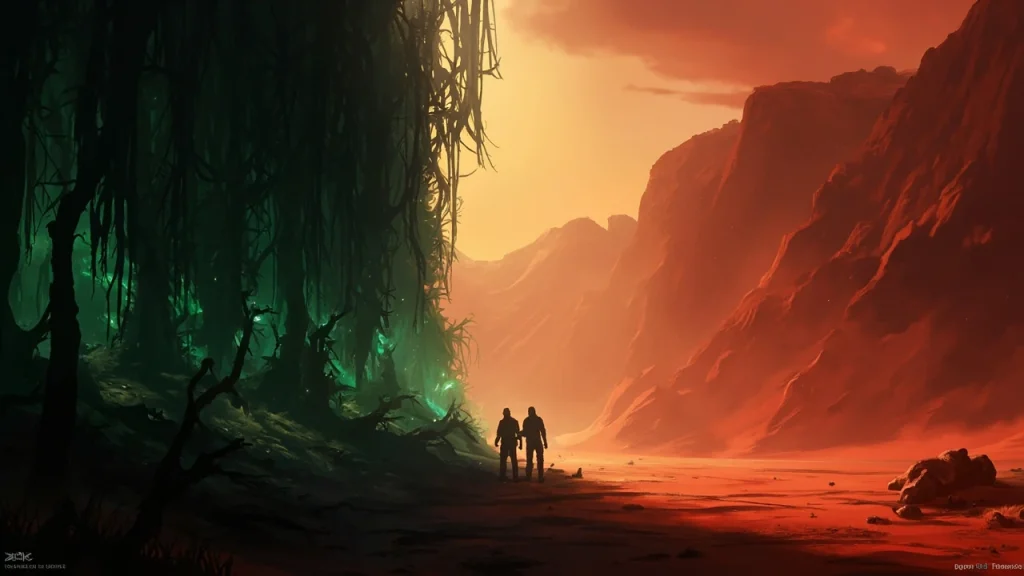
Chaos forest crimson desert: how a biome pair can carry a whole open world
A player who has spent real hours in a large action RPG rarely remembers a single quest step. What they remember is the moment a corrupted woodland gives way to red sand under their boots, and the game suddenly asks them to navigate, fight, and rest in unfamiliar conditions. The pairing of a chaotic forest biome with a crimson desert biome is one of the more studied environment transitions in modern open world design, because it stresses almost every system a studio has to ship: streaming, encounter scripting, navigation, lighting, audio, quest gating, and wayfinding. The phrase chaos forest crimson desert has become shorthand inside studios for a design pattern in which two adjacent regions have radically different rules, and the seam between them is itself a design surface. This article looks at that pattern from a development and production angle, not a fan or marketing one, and grounds its examples in the kinds of decisions a real team has to make when a forest and a desert share a border on a single world map.
The intent here is implementation, not promotion. If you are a level designer trying to decide how a forest and a desert should meet, a technical artist budgeting the streaming cost, a producer sequencing art and content handoffs, or an audio designer mixing two distinct ambient beds along one boundary, the questions are similar. What should the player see from the forest? How loud should the wind be? Where do encounters reset? Which biome owns the road, and which owns the player? We will work through the biome pair as a design problem, look at how studios have historically handled similar transitions, and end with practical checks a team can apply before the first vertical slice is locked.
Why a forest-desert pair is harder than it looks
On paper, a chaos forest and a crimson desert are simple environmental art tasks. One is dark, dense, and vertical; the other is bright, sparse, and horizontal. In production, the hard work begins at the seam. The seam is the strip of terrain where the two biomes meet, and it is the part of the world players will see in every loading screen trailer, every marketing screenshot, and every YouTube thumbnail. It is also the strip that breaks if streaming, pathing, lighting, and audio are not budgeted together.
Studios that ship large open worlds tend to treat the seam as a separate piece of content rather than a leftover between two pieces of content. That means the seam has its own blockout, its own encounters, and its own performance budget, even though it might only be a few hundred meters wide on the world map. The biome pair is also asymmetric by design: forests tend to constrain the camera, while deserts open it up. That asymmetry is what gives the pairing its emotional power, but it is also what creates its technical risk, because the engine has to handle two very different draw profiles within a short walk.
Defining the chaos forest biome as a design object
Before discussing the transition, it is worth being precise about what a chaos forest biome is meant to do for a player. In the games that use this terminology, the forest is not a generic woodland. The word “chaos” usually signals three things at once: corrupted or mutated flora, an encounter profile that is aggressive and reactive, and a navigation model that punishes the player for going off the path. The player should feel that the forest is doing something to them, not just surrounding them.
That intent drives concrete decisions. Trees lean inward, so the canopy reads as closing rather than as shelter. Ground cover is dense, so the player’s footsteps sink visually and audibly. Encounter scripting prioritises ambushes, with enemies placed behind trunks, in low fog, and on elevated root platforms. Lighting is low and directional, so the player reads silhouettes more than textures. The forest’s job is to compress the player’s view, compress their movement options, and compress their time to react. When those three compressions line up, the biome feels chaotic without needing a single monster in shot.
Defining the crimson desert biome as a design object
A crimson desert biome does the opposite work. It opens the camera, opens movement, and opens reaction time. Red sand reads as a single dominant hue, which simplifies the player’s visual parsing and lets the team push the silhouette game harder in the distance. The desert’s job is to make the player feel exposed, and to make the player’s choices about path, pace, and engagement more visible to themselves.
Mechanically, the desert usually offers longer sightlines for ranged combat, more open flanks for cavalry or vehicle play, and a stronger reliance on heat, stamina, and resource systems. Audio is dominated by wind and by distant sounds, because there are no trees to absorb noise. The desert also tends to host the largest set pieces, because the player can actually see them from far away. A single ruined tower on a red ridge can act as a landmark for an entire quadrant of the map, which is a luxury the forest rarely allows.
What changes at the seam
The seam is where the two design intents collide, and where most of the production risk lives. A good seam does four things at once. It gives the player a visible signal that the rules are about to change. It gives the technical team a stable place to swap streaming sets, ambient beds, and encounter pools. It gives the quest system a clean trigger zone for new mechanics, such as heat damage or forest corruption. And it gives the audio team a crossfade that the player can feel in their body, not just hear with their ears.
When any of those four jobs is missed, the seam feels arbitrary. A player walks from red sand into dark trees and keeps the same UI prompts, the same encounter density, the same wind volume, and the same draw distance. The transition reads as a texture swap rather than as a world change. The fix is rarely to add more art at the seam. The fix is almost always to add more systems at the seam, in the right order, and to make the systems visible.
Visual signals: silhouette, color, and density
Visual work at the seam is mostly subtraction. In the forest, the team strips sky and horizon to force the player into trunks, roots, and fog. In the desert, the team strips trunks and ground cover to force the player into ridges, dunes, and sky. The seam is where the player’s eye has to re-learn what to look at. Studios usually achieve this with a transition zone about thirty to sixty seconds of walking wide, in which canopy cover drops from near one hundred percent to near zero, and in which ground texture shifts from dark organic matter to red sand with embedded rock.
Color is the cheapest and most reliable signal. Red sand under a warm sky reads differently from dark loam under a green canopy, and the player’s brain registers the change before the quest log does. Density is the second signal. If the player can see more than about one hundred meters in the forest, the forest has failed; if the player can see less than about three hundred meters in the desert, the desert has failed. The seam is the place where those two failure modes meet, and where the team has to commit to one set of numbers.
Audio signals: how a forest and a desert sound at the same volume
Audio is where biome pairs tend to be designed in isolation rather than in conversation, and where the seam is most often faked after the fact. A forest ambient bed is built around near-field sounds: creaks, insects, drips, the rustle of leaves, and the player’s own footsteps with their characteristic muffled quality. A desert ambient bed is built around far-field sounds: sustained wind, distant crashes, low rumbles, and the player’s own footsteps with a dry, crunching attack.
Both beds are correct in isolation. At the seam, they fight each other. The fix is to design the seam’s audio as a third bed, not as a crossfade between two beds. That third bed starts in the forest’s bed, drops the near-field layers as the canopy thins, introduces wind as a sustained layer rather than as a one-shot, and only then hands off to the desert bed once the player is fully clear of the treeline. The handoff should take roughly the same number of seconds as the visual transition, so the player’s ears and eyes agree about where they are.
Streaming and world partition: paying for two biomes next to each other
Streaming is the most common silent failure mode of a biome pair. The forest and the desert have different LOD profiles, different shadow casters, different particle budgets, and different audio voice counts. If both profiles are loaded at the seam, the player gets a hitch. If the wrong profile is loaded, the player gets the wrong silhouette for several seconds. Studios usually handle this with a hard rule: the seam owns one streaming cell, and that cell is allowed to know about both biomes, but no other cell is.
For an Unreal-style World Partition setup, that means the seam cell has both forest and desert HLOD layers, and the cell outside the seam only has the layer it belongs to. For an open world built on a custom streaming system, it means the seam is its own streaming object with a known memory budget, and the cells on either side do not double-load the assets that live in the seam. The technical cost of the seam is real and should be booked early, not discovered in the back half of optimisation.
Encounter design at the boundary
Encounter design at the seam is the part of the biome pair most often left to feel, when in fact it is the part most worth scripting. The forest wants ambushes; the desert wants pursuit. The seam is where the player should feel both at once. That can be done by scripting an encounter that starts in the forest, chases the player out into the desert, and then becomes a different encounter because the sightlines change. The same enemy group can read as terrifying in the forest and manageable in the desert, which is a useful tool for tuning difficulty without changing stats.
Encounter designers can also use the seam to introduce mechanics that only make sense at the boundary. A “corrupted wind” effect, for example, can be invisible in the forest, audible in the seam, and lethal in the desert. A “heat shimmer” effect can be absent in the forest, faint in the seam, and constant in the desert. These graded mechanics are how a world tells the player that the rules have changed, without relying on a tutorial popup.
Wayfinding and the player’s mental map
One of the under-appreciated jobs of a biome pair is to give the player a way to remember the world. A chaos forest is hard to map, because the player can see only a few meters in any direction. A crimson desert is easy to map, because the player can see for hundreds of meters and can use distant landmarks to triangulate. The seam is the moment the player’s mental map upgrades from a local node graph to a regional line graph, and the design should respect that shift.
Practical wayfinding choices follow from that observation. Place a single tall landmark on the desert side of the seam that the player can see from inside the forest, even if the landmark is not yet unlocked. Use the forest’s pathing to funnel the player toward the seam, rather than offering branching routes that delay the visual reward. Use the desert’s openness to let the player choose their next destination, rather than scripting the next quest step. The seam is the moment the game hands the player a compass and stops holding their hand.
Quest gating and story beats at the border
Quest designers often treat the biome boundary as a hard gate, where the player cannot proceed until a story condition is met. That is a legitimate choice, but it is not the only one. The boundary can also be a soft gate, where the player can cross freely but the encounters and rewards change, and the story beats react to the player’s choice. Hard gates are clearer and easier to test; soft gates are more respectful of player agency and more replayable. The decision between them should be made per quest, not per biome.
For a story-driven open world, the seam is also a natural place to put a single major set piece, because the player will be there once and will remember it. That set piece can be a small camp, a ruined outpost, a quest giver standing at the treeline, or a story moment that depends on the contrast between the two biomes. The set piece should not be over-designed, because the forest and the desert are already doing the heavy lifting. A single NPC, a single fire, and a single line of dialogue at the seam will land harder than a fully built village in the middle of either biome.
Performance budgets for a chaos forest crimson desert pairing
Performance budgets are where biome pairs usually get audited. The forest is dominated by opaque geometry, dense instanced foliage, screen-space shadows, and short-range audio. The desert is dominated by terrain, long-range shadow casters, large particle systems for dust and heat, and long-range audio. Neither is cheap, and the seam is the place where both have to be paid for at once. The following table shows a reasonable starting budget for the seam cell, with the assumption that the surrounding cells only pay for their own biome.
| Resource | Forest cell target | Seam cell target | Desert cell target |
|---|---|---|---|
| Triangles on screen | 2.5 to 3.5 million | 3.0 to 4.0 million | 2.0 to 3.0 million |
| Draw calls per frame | 1,800 to 2,400 | 2,200 to 2,800 | 1,400 to 2,000 |
| Audio voices active | 24 to 32 | 28 to 40 | 18 to 26 |
| Streaming memory | 320 to 450 MB | 520 to 700 MB | 280 to 400 MB |
| Particle systems | 40 to 70 | 60 to 90 | 30 to 60 |
| Shadow casters (long range) | Low | Medium | High |
| Far clip distance | 120 to 180 m | 250 to 400 m | 600 to 900 m |
The seam cell is intentionally the most expensive cell in the region. That is a design choice, not a failure. The seam is short, the player passes through it once per traversal, and the cost is justified by the visual and audio work the seam has to do. The numbers in the table are starting points; the real budgets come from profiling a representative slice on representative hardware, and from comparing the seam’s cost to the cost of the surrounding cells in the same frame.
Lighting and time of day at the boundary
Lighting is where a forest and a desert can disagree violently if they are not coordinated. A forest at noon is a dark green cave with shafts of light. A desert at noon is a flat red plane with a single dominant light direction. The two scenes share the same sun but not the same exposure, the same ambient, or the same post-process curve. At the seam, the player will see both within seconds, and their eyes will need to adapt.
Two patterns help. The first is to author the seam’s lighting as a third setup, with its own exposure and its own post-process curve, so the transition is gentle on the eye. The second is to bias the time of day for which the seam is designed. If the seam is meant to read at midday, it can be tuned for the harshest lighting case. If it is meant to read at golden hour, it can be tuned for the most flattering lighting case. The decision should be made by the art director and the lighting lead, not by individual lighting artists working in isolation.
Navigation and pathing across two terrain types
Navigation meshes in a forest and a desert are built differently. Forest navmeshes are dense, follow narrow corridors between trunks, and use a lot of off-mesh links for jumping, climbing, and dropping. Desert navmeshes are sparse, follow ridge lines and dry riverbeds, and rely on long open stretches for mounted or vehicle movement. The seam is where the navmesh has to do both, and where AI can get confused if the rules are not explicit.
A practical rule is that AI should be told which biome it is in, not allowed to infer it from the navmesh. Enemies designed for the forest should not path into the desert unless the encounter is scripted to do so, and vice versa. Stray AI that crosses the seam and then gets stuck is a common QA flag, and the fix is usually a designer-authored exclusion zone, not a code change. The exclusion zone should be invisible to the player and should be drawn on the level design map during blockout, not added in late polish.
Animation and motion vocabulary at the seam
Animation is where biome pairs are often over-designed, because the temptation is to ship two full animation sets, one per biome. A more sustainable approach is to share a base locomotion set, and to layer biome-specific behaviour on top. The forest can demand tighter turns, lower stances, and more reactive idle transitions. The desert can demand longer strides, more upright posture, and more frequent look-outs. The seam is where the two behaviour layers blend, and where the animator’s job is to keep the blend readable.
Motion vocabulary also affects the player’s sense of pace. A forest traversal that takes fifteen real minutes will feel short if the locomotion is busy. A desert traversal that takes fifteen real minutes will feel long if the locomotion is busy. The seam is the moment the game’s sense of time changes, and animation is a large part of how that change is communicated.
Comparing the biome pair to other classic transitions
The chaos forest and crimson desert pair is one of several well-known biome transitions in open world design. Comparing it to other pairs is useful because the comparison exposes which decisions are specific to this pair and which are general. The table below compares four common biome pairs on the dimensions that matter for level design and production.
| Biome pair | Player’s view | Dominant audio | Encounter profile | Streaming cost | Wayfinding load |
|---|---|---|---|---|---|
| Chaos forest to crimson desert | Compresses, then opens | Near-field to far-field | Ambush to pursuit | High at the seam | Local to regional |
| Snow peak to green valley | Opens, then compresses | Wind to foliage | Sparse to dense | Moderate at the seam | Regional to local |
| Swamp to highland plain | Compresses, then opens | Insects to wind | Slow attrition to skirmish | High at the seam | Local to regional |
| Coastal cliffs to inland forest | Opens, then compresses | Surf to insects | Skirmish to ambush | Moderate at the seam | Regional to local |
The chaos forest to crimson desert pair is the only one in the table that combines a compressed view with a far-field audio bed at the destination. That combination is what gives the pair its distinctive feeling of relief when the player clears the treeline, and it is also what makes the seam expensive to author. Studios that have shipped a similar transition in other games have usually done so by treating the audio and the visual transition as a single authored event, rather than as two systems that happen to be scheduled in the same cell.
Production sequencing: when each part of the biome is built
Production sequencing for a biome pair is not the same as production sequencing for a single biome. The forest and the desert can be built in parallel by separate teams, but the seam cannot. The seam has to be built last, after both biomes are at a near-final state, because its job is to reconcile the two. A common production failure is to assign the seam to a junior team member as a “glue” task, and to discover in late optimisation that the seam is the most expensive cell in the region.
A safer sequencing is to nominate a single designer, technical artist, and audio designer as the seam owners, and to give them authority over both biomes’ final blockout. The seam owners should review the forest and the desert at the same milestones, and should be the final sign-off on the transition. This avoids the situation in which the forest team and the desert team each believe the other team owns the seam, and the seam ends up being built by whoever runs out of time last.
Risk register: what can go wrong with a chaos forest crimson desert pair
Most of the risk in a biome pair is concentrated at the seam, and most of that risk is the same risk repeating with different costumes. The list below is a starting risk register that a producer or lead can use to drive reviews at each milestone. It is not exhaustive, and it should be adapted to the project’s actual constraints, but it covers the categories of failure that recur in shipped open worlds.
- Streaming hitch at the seam, caused by both biomes’ HLOD layers loading in the same cell.
- Audio crossfade that the player hears as a sudden cut, because the wind layer is introduced as a one-shot instead of a sustained bed.
- Encounter bleed, in which forest enemies path into the desert and then idle in place, or desert enemies path into the forest and then get stuck on trunks.
- Visual mismatch, in which the forest’s last trunks are still in the desert’s near distance, or the desert’s first dune is still inside the forest’s fog.
- Quest gating that the player perceives as a wall, because the biome change is not signalled before the gate.
- Performance regression, in which the seam cell is the single most expensive cell on the map and is not flagged in profiling.
- Lighting pop, in which exposure or post-process settings change abruptly when the player crosses the seam.
- Wayfinding failure, in which the player cannot see a landmark from inside the forest, or sees a landmark they cannot yet reach.
- Animation pop, in which the player’s locomotion set swaps abruptly instead of blending over the transition.
- Save data mismatch, in which biome-specific quest state is saved against the wrong biome and triggers the wrong encounters on reload.
Each of these risks has a known owner on most teams, and a known milestone at which it should be reviewed. The producer’s job is to make sure the review happens and that the action items from the review are tracked into the next milestone, not deferred to a polish pass.
Reference reading on open world biome design
For readers who want to dig further into the design vocabulary used in this article, two resources are worth a careful read. The first is the public English article on the open world action RPG whose biome pair is the reference for many of the examples above, available on its Wikipedia entry for Crimson Desert, which provides useful background for this point. The second is a third-party review of the same game that discusses, among other things, how the world handles the transition between heavily forested regions and the broader desert, published as a review of Crimson Desert on Press Start, which provides useful background for this point. Neither source is a development manual, but both are useful as a shared reference for how players describe the same biome pair, and for how the studio’s work reads from the outside.
Pre-production checklist for a forest-desert biome pair
The checklist below is the kind of artefact a lead designer or producer would put on a shared drive before the first blockout of a chaos forest crimson desert pair. It is intentionally short, because a long checklist at pre-production is rarely read. Each item maps to a concrete deliverable, and each deliverable maps to a milestone.
- Authored one-paragraph design intent for the forest and one for the desert, naming what the player should feel and what they should not.
- Authored a separate design intent for the seam, naming what the player should learn at the boundary.
- Defined the seam cell’s memory, draw, and audio budgets, and recorded them in the technical design document.
- Assigned a single owner for the seam across design, technical art, and audio.
- Built a paper blockout of the seam with encounter, audio, and wayfinding annotations before any greybox is placed.
- Profiled a representative forest cell, a representative desert cell, and the seam cell on representative hardware, and recorded the numbers.
- Built a reference camera flythrough that the art director and lighting lead can use as the lighting target for the seam.
- Authored the audio handoff as a third bed, not as a crossfade, and recorded its layers in the audio design document.
- Decided per quest whether the boundary is a hard gate or a soft gate, and recorded the decision in the quest design document.
- Scheduled a seam-specific review at each major milestone, with the forest and desert leads present.
Frequently asked questions
What does “chaos forest crimson desert” mean in open world design?
In open world design, the phrase refers to a biome pair in which a corrupted or mutated forest is placed next to a red sand desert, and the seam between them is treated as a designed surface. The forest compresses the player’s view, audio, and encounter profile; the desert opens them. The design job is to make the transition between those two states feel intentional, technically stable, and readable to the player in a single traversal.
Why is the seam between two biomes usually more expensive than either biome alone?
The seam is more expensive because it has to pay for both biomes at once. It loads the forest’s dense foliage, the desert’s long-range shadow casters, and a third audio bed that hands off between the two ambient profiles. The memory, draw, and audio budgets for the seam cell are typically higher than the budgets for either of the cells on either side of it, and that higher cost is a deliberate design choice, not a failure of optimisation.
How wide should a forest-desert transition zone be?
A practical rule is that the transition should take the player about thirty to sixty seconds of normal walking to cross. That window is long enough for the visual, audio, and encounter systems to hand off, and short enough that the player does not lose the sense that they have moved between two real places. Wider transitions are usually a sign that one of the biomes has not committed to its own design, not a sign of higher production value.
Should the biome boundary be a hard quest gate or a soft one?
That is a per-quest decision, not a per-biome decision. Hard gates are clearer, easier to test, and better for story beats that depend on the player’s first sight of the new biome. Soft gates are better for replayability and for player agency, and they let the world’s systems react to the player’s presence rather than to a single story condition. A well-designed open world usually uses both, in different places, and labels the choice in the quest design document so the design intent is auditable.
How do you keep the player oriented across a forest and a desert?
Use the biome pair to upgrade the player’s mental map rather than to reset it. The forest should funnel the player toward a single tall landmark on the desert side, which the player can see before they leave the trees. The desert should then let the player choose their next destination, rather than scripting the next quest step. The seam is the moment the game hands the player a compass and stops holding their hand, and wayfinding design should respect that shift.
What is the most common production mistake with a biome pair?
The most common mistake is to assign the seam to a junior team member as a glue task, and to discover in late optimisation that the seam is the most expensive cell in the region. The safer pattern is to nominate a single owner across design, technical art, and audio for the seam, and to give that owner the authority to sign off on both biomes’ final blockout. The seam is short, but its work is disproportionate to its size.
How do you avoid an audio pop when crossing from forest to desert?
Author the seam’s audio as a third bed, not as a crossfade between the forest and desert beds. The third bed starts in the forest’s bed, drops the near-field layers as the canopy thins, introduces wind as a sustained layer rather than as a one-shot, and only then hands off to the desert bed once the player is fully clear of the treeline. The handoff should take roughly the same number of seconds as the visual transition, so the player’s ears and eyes agree about where they are.
Can a single animation set cover both biomes?
Usually yes, if the set is treated as a base locomotion layer and the biome-specific behaviour is added on top. The forest can demand tighter turns, lower stances, and more reactive idle transitions. The desert can demand longer strides, more upright posture, and more frequent look-outs. The seam is where the two behaviour layers blend, and the animator’s job is to keep the blend readable. Shipping two completely separate animation sets for two adjacent biomes is rarely worth the cost.
How do you profile a biome pair without profiling the whole world?
Profile three representative cells: a forest cell, a desert cell, and the seam cell. Use the same representative hardware, the same representative build, and the same time of day, and record the triangle count, draw call count, audio voice count, and streaming memory for each cell. The seam cell should be the most expensive of the three by design, and the numbers should be recorded in the technical design document so the budget is auditable at every milestone.
What should a designer do if playtesters feel nothing at the boundary?
That is usually a sign that one of the four seam jobs has been missed. Either the visual signal is not strong enough, the audio handoff is too gentle, the encounter profile has not changed, or the quest system is not telling the player that the rules are different. The fix is to add one more system at the seam, in the right order, and to make it visible. The fix is rarely to add more art at the seam, because the forest and the desert are already doing most of the work.