
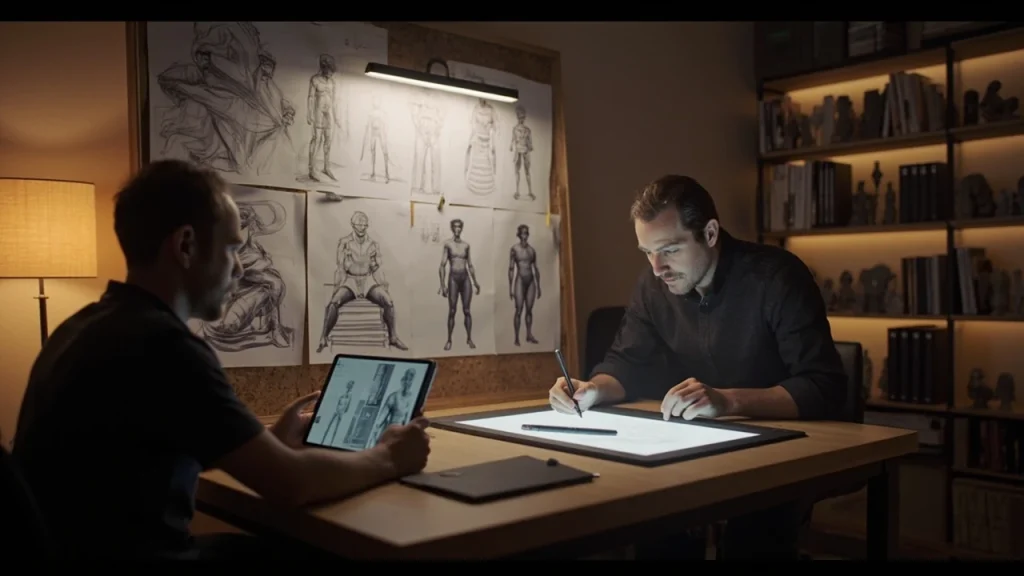
Character design services for games: what a studio actually delivers
A production lead opens a folder labelled “hero character”, and inside sit two concept sketches, a turnaround, three expression sheets, a ZBrush blockout, and a colour key. That bundle is what most studios mean by character design services: the full chain of work that turns a written brief into a character an animator, a modeller, and a rigger can all use without reinterpreting the idea. The phrase is short, but the work behind it spans concept art, orthographic turnaround, silhouette iteration, costume breakdown, props, expression sheets, and enough technical information for downstream teams to keep moving.
For game teams, the value of these services is not aesthetic novelty on its own. The value is the reduction of decision risk. A good character package answers the questions that would otherwise stall production: how the silhouette reads at gameplay distance, where the joints break, how the costume reads against a specific environment, which details survive compression on a mobile asset, and how the design reacts to lighting variants. When those questions are answered before greybox, the team avoids paying for a hero asset that has to be redrawn six months later because the cape clips through the rig or the face loses its identity under stylised lighting.
This article is written for producers, art directors, and studio leads who need to commission character work, and for senior concept artists who want to understand the production framing their clients operate in. It walks through scope, deliverables, pricing logic, file standards, review cycles, and the failure modes that make a delivered character unusable. The focus is on games specifically, because the constraints of real-time rendering, animation budgets, and platform certification change what “finished” means compared with film or print work.
How character design services fit into a game’s production pipeline
Character design services rarely exist as a single artefact. They sit between pre-production and the start of asset production, and they feed every downstream discipline. Understanding that position is the difference between ordering “a character drawing” and ordering work that the whole studio can build on.
In a typical AAA or AA pipeline, the chain looks like this:
- Pitch and treatment. A short document frames the character in narrative tone, audience rating, gameplay role, and reference inspirations.
- Silhouette exploration. Multiple black-and-white thumbnails test proportion, posture, and silhouette readability at thumbnail size.
- Key frames and final concept. Two or three fully rendered concepts compete for selection, often with a costume variant each.
- Turnaround and callouts. A clean front, side, and three-quarter view plus callouts for materials, accessories, and joint locations.
- Expression and pose sheets. The face and body language needed for cinematics, UI portraits, and marketing.
- Technical handoff. Layered files, palette swatches, material notes, polygon budget, and naming conventions that 3D, rigging, and animation can use directly.
For indie teams the chain is often compressed, but the order matters. A studio that skips the silhouette stage usually ends up iterating on a finished render instead of iterating on the strongest idea, which costs more than the saved stage would have.
Core deliverables a character design package should include
Buyers sometimes receive only one or two of the items below, which is one of the most common causes of unusable character art. A complete package is closer to a small reference library than a single image.
| Deliverable | Format expectations | Who uses it downstream | What it prevents |
|---|---|---|---|
| Silhouette sheet | 8 to 12 black-and-white thumbnails at consistent size | Art director, lead designer | Late-stage redesign because the shape fails at gameplay distance |
| Final concept render | One hero pose, 4K or larger, layered source file | Marketing, art direction sign-off | Misalignment on the chosen direction before turnaround starts |
| Orthographic turnaround | Front, side, three-quarter, back at matched scale | 3D modellers, riggers | Asymmetric proportions and inconsistent joint placement |
| Costume and prop callouts | Layered file with named groups and material notes | Character artists, technical artists | Material misinterpretation and lost accessories in 3D |
| Expression sheet | Six to ten expressions with eye and brow detail | Facial riggers, cinematic animators, UI portrait team | Loss of personality in cinematics and dialogue scenes |
| Pose sheet | Action, idle, and signature poses with motion notes | Animators, combat designers | Stiff or off-model animation passes |
| Colour and material key | Palette swatches, material reference, lighting notes | Look development, lighting artists | Inconsistent palette across cinematics and gameplay |
| Handoff document | Polygon budget, texture count, naming, edge cases | Producers, character art lead, outsourcing coordinator | Misrouted files, re-export, and review churn |
The handoff document is the most underestimated item on the list. Studios that skip it usually pay for the omission in re-export and re-review time during the 3D stage, when those hours are at their most expensive.
Where external character design services add the most value
Outsourcing is a structural decision, not a budgetary reflex. The best reasons to bring in a partner for character design services are not generic “saving money” claims but specific production risks the in-house team cannot cover.
- Capacity spikes. A studio has a feature lock in eight weeks and needs three hero characters ready for greybox. In-house concept art is busy supporting gameplay and environments.
- Specialist style. A project requires a comic inking style, a painterly RPG look, or a specific cultural costume tradition that the permanent team has not shipped before.
- Volume of secondary characters. A narrative game has forty named NPCs and the team can only concept three at the internal quality bar.
- Time-zone overlap. A partner studio can hand off turnaround sheets in the morning, freeing in-house artists to focus on integration and review.
- Independent review. An outside art director can spot inconsistency between characters that an internal team has grown used to.
There are also situations where external character design services are the wrong choice. A studio that does not yet have a clear visual direction will spend the external budget on iterations that should have happened internally. A team without a lead artist who can review against the game’s existing bar will receive work it cannot judge. The partner is not a substitute for internal direction; it is a force multiplier on top of it.
Writing a brief that protects the budget and the schedule
Most character design briefs fail at the same points. They describe what the character looks like, but not what the character does, where the player meets them, or what the downstream teams need. A defensible brief covers five sections in plain language.
- Role and context. Who is this character in the story, what is their gameplay function, and what is the first impression the player should have.
- Visual references. Three to five images that capture the intended tone, with notes on what to copy and what to avoid. Mood references are useful, but “in the style of” references tied to a single named artist often create IP and consent issues.
- Constraints. Engine, target platform, polygon and texture budget, costume complexity, and any certification rules that affect skin exposure or cultural accuracy.
- Deliverable list and format. The exact artefacts from the table above, with file types and resolution named.
- Review milestones and acceptance criteria. What counts as a pass at each stage and how feedback will be consolidated into a single list per round.
Briefs written this way reduce the most expensive failure mode in outsourced art: divergent expectations. When both sides agree that “approved silhouette” means the same thing, the next stage can start without a renegotiation.
Pricing models for character design services and what they hide
Character art pricing is presented in several forms, and each one shifts risk in a different direction. The three most common structures are time-based rates, per-deliverable quotes, and project-based fixed bids.
| Model | How it is calculated | Who carries schedule risk | Best fit |
|---|---|---|---|
| Hourly or daily rate | Tracked hours at a published rate | Buyer, unless a hard cap is set | Exploration and early iteration |
| Per deliverable | Fixed price per silhouette sheet, turnaround, expression sheet, and so on | Studio, when scope is well defined | Repeatable secondary characters |
| Project-based fixed bid | One number for a defined package, usually with revision rounds | Studio, but with revision caps | Hero characters with a clear brief |
| Hybrid | Lower fixed scope plus a rate for additional revision rounds | Shared | Long collaborations with shifting scope |
The headline number matters less than what is inside it. A quote that excludes layered source files, expression sheets, or handoff documentation can look cheaper and end up costing more once internal artists redo that work. Equally, a quote that bundles a “marketing render” with the production package usually hides a render artist’s hours inside a single line item, which makes the production work appear more expensive than it is.
Reputable studios publish a list of what is included at each tier and how additional revision rounds are billed. Buyers should ask for that list in writing before signing, because “unlimited revisions” almost never means unlimited in practice, and “minor changes” is a term that will be defined differently by each side if it is not pinned down in advance.
Review cycles that protect quality without burning the budget
Reviewing concept art is a discipline, not a reaction. The fastest way to overspend on a character package is to give the partner a long unstructured Slack thread of feedback. The fastest way to receive poor work is to give no feedback at all. The middle ground is a small process with named roles and a fixed cadence.
- One consolidated feedback list per round. All comments come through a single document or a single ticket. Side-channel feedback is funnelled in by the producer or art lead before the next round starts.
- Decisions before notes. Each round ends with an explicit “approved”, “approved with notes”, or “rejected” decision. Notes without a decision force the partner to guess priorities.
- Limits on revision rounds. Two to three rounds per stage is typical for production-quality work. Beyond that, the brief is usually the problem, not the art.
- Named approver. One person has sign-off authority per character. Committees produce blended, expensive work.
- A freeze at turnaround. Once the orthographic sheets are signed off, silhouette, proportion, and major costume decisions do not reopen. Texture, lighting, and minor accessories can still iterate.
A freeze at turnaround is unpopular the first time a team uses it, because it feels premature. In practice, it is what protects the schedule. Every change after turnaround is paid for in modeller hours, rigger hours, and re-export time, which are roughly an order of magnitude more expensive than concept art hours.
File standards and technical handoff
Concept art that looks finished but cannot be opened cleanly by the next artist is a common cause of friction. A small list of file conventions, agreed up front, prevents most of it.
| Asset | Recommended format | Why |
|---|---|---|
| Layered source files | .PSD, .Krita, or .clip with named layer groups | Allows material, costume, and prop separation downstream |
| Reference board | PDF or shared link with annotations | Preserves the brief context for future hires |
| Turnaround | PNG or PSD at consistent scale with grid overlay | Matches the scale reference used by the 3D team |
| Colour palette | .ACO or ASE with named swatches | Keeps palette consistent across UI, VFX, and marketing |
| Handoff document | Markdown or PDF with budget, naming, and edge cases | Remains readable long after the original artist has left |
Most studios keep their conventions in a short “character art bible” that the partner receives alongside the brief. Updating that bible between projects is what separates a team that ships on schedule from one that re-invents the same standards on every title.
IP, licensing, and ownership
Character design services produce work that is, by default, owned by the studio that commissioned it, but the default only applies when the contract is clear. Three issues come up often enough to be worth addressing in the agreement rather than after delivery.
- Work-for-hire language. The contract should state that all delivered work, including unused exploration, is a work made for hire and assigned to the buyer. Some jurisdictions do not recognise “work for hire” as a legal term, so a fallback assignment clause is necessary.
- Reference ownership. If the partner uses AI-assisted tools during exploration, the contract should state whether outputs are permitted, what data was used to train or prompt them, and what rights the buyer receives. Many publishers and platform holders restrict AI-generated content, and the contract should match the buyer’s policy.
- Reuse and portfolio rights. Studios usually want the right to use the character in marketing, sequels, ports, and related media. Partners usually want the right to show the work in their portfolio, sometimes only after the game is announced. Both points are reasonable and should be written down.
Skipping this section is the single most common cause of disputes that reach legal review. The cost of a clear contract is small compared with the cost of a character that cannot be shipped because ownership is contested.
How to evaluate a partner before signing
Portfolios are necessary but not sufficient. A studio can have beautiful work and still be the wrong partner for a specific project. A short evaluation pass before contract reduces the risk of a costly mismatch.
- Compare portfolio pieces against your engine and platform. A studio whose best work was painted for a 4K PC cinematic may or may not adapt to a stylised mobile hero. Ask for examples at your target fidelity.
- Test the brief on a small paid pilot. One silhouette sheet, with a fixed deadline and fixed revision count, tells you more about a partner than any number of portfolio reviews.
- Check turnaround time and review responsiveness. Concept work that arrives on schedule but does not respond to notes quickly is more expensive than work that takes a day longer but iterates cleanly.
- Confirm file conventions in advance. Ask for a sample layered file and a handoff document from a past project. The structure will look very similar to what you will receive.
- Read the contract end to end. Ownership, AI policy, revision caps, and termination terms should be plain language, not buried in a master services agreement.
For teams without an in-house art director, a paid pilot is especially useful because it produces an objective artefact that other stakeholders can review. The pilot cost is small compared with the cost of a multi-month contract that has to be cancelled after the first month.
Common failure modes and how to prevent them
Most character design packages fail in the same handful of ways, and most of those failures trace back to brief, review, or freeze decisions rather than to the artist’s skill. The list below names the patterns that show up most often in post-mortems.
- The “pretty but unriggable” hero. Long hair, asymmetric pauldrons, and floating belts look great in the concept and break the rig. Constraint the silhouette early.
- The “inconsistent between characters” set. Two partners work on similar characters at the same time with no shared reference. Run a calibration round on a single character before unlocking the rest.
- The “infinite revision” trap. Notes keep arriving because there is no freeze point. Approve at silhouette and at turnaround, not after every render.
- The “no handoff” delivery. The package is beautiful, but the modeller cannot find the seams. Require a handoff document before final payment.
- The “style drift” project. The character looks fine on its own but clashes with the existing cast. Compare against a reference board of approved characters before signing off.
Each of these failures is recoverable if caught at the right stage and expensive if caught after greybox. The cheapest detection is a one-page checklist reviewed at each milestone.
What a healthy client relationship looks like
The studios that get the best work from external character design services tend to behave the same way. The patterns are simple, but they are not automatic, especially under deadline pressure.
- They share reference material generously, including work they are not proud of, because context reduces rework.
- They respond to review questions within one business day so the partner can keep working.
- They consolidate feedback through one channel and one approver.
- They pay on the agreed schedule, because late payment is the fastest way to lose a partner’s best artists to other clients.
- They tell the partner when the work is good, not only when something needs to change.
External partners are not interchangeable vendors. The studios that treat them as long-term collaborators, with shared standards and mutual respect, end up with a roster of trusted partners who already understand the visual language of the project. That roster is one of the most durable production assets a studio can build.
For teams that are commissioning character work for the first time, the path forward is rarely a single large contract. It is a paid pilot, a careful review, a clear contract, and a small list of checkpoints that both sides can hold each other to. For teams with established partners, the path is to keep refining the brief, the freeze points, and the handoff document so each project starts a little further along than the last. Either way, the goal is the same: characters that survive the move from concept to real-time engine, on schedule, with the integrity of the original idea intact.
Studios that invest in that discipline tend to find that character design services become less of a gamble and more of a predictable part of pre-production, and that the characters they ship carry their original intent all the way to the player. For a closer look at how the practical side of partner work shapes a real project, the production breakdown behind La Grande Combination: a developer breakdown of a turn-based RPG design pattern shows how design decisions are documented in a finished game. On the marketing and audience side, the analysis of indie releases that turn small constraints into hit games is a useful reference for the kind of character clarity that helps a small team stand out.
Frequently asked questions
What does a typical character design services package include?
A complete package usually includes a silhouette sheet, one or more final concept renders, an orthographic turnaround, costume and prop callouts, an expression sheet, a pose sheet, a colour and material key, and a technical handoff document. The exact list varies by project, but the turnaround and the handoff document are the two artefacts that almost always need to be in scope.
How long does a single hero character take from brief to approved turnaround?
For a senior concept artist working full time, a hero character typically takes three to five weeks from approved brief to signed-off turnaround, with one to two weeks of that spent on silhouette exploration. Faster timelines are possible for stylised designs with clear references, and slower timelines are normal for grounded, research-heavy designs such as historical or cultural projects.
How is pricing usually structured for character design services?
Pricing is usually offered as an hourly rate, a per-deliverable quote, a project-based fixed bid, or a hybrid that combines a fixed scope with a rate for extra revision rounds. The right model depends on how well the brief is defined and how much scope risk the studio is willing to carry.
How many revision rounds are reasonable?
Two to three revision rounds per stage is typical for production-quality work. Beyond three rounds, the cause is usually an unclear brief, an inconsistent reference board, or a missing approver, and adding more rounds rarely fixes the underlying issue.
Who should own approval of the final character?
One named approver per character, usually the art director or the lead artist, with the producer or outsourcing coordinator consolidating feedback. Committee approval tends to produce blended, expensive work because no single point of view drives the decisions.
What should a studio prepare before commissioning a partner?
Prepare a brief that covers the character’s role, gameplay function, references, technical constraints, and the deliverable list. Also prepare a short style guide or character art bible so the partner can compare new work against the existing cast, and run a paid pilot on one character before committing to a larger contract.
How are IP and licensing usually handled?
Most contracts treat the work as work made for hire, with full assignment to the buyer and clear terms for the partner’s right to show the work in a portfolio after announcement. Contracts should also cover AI-assisted tooling if it is used, including what data was involved and what rights the buyer receives.
Can character design services be used for live operations content?
Yes, and they often are. Seasonal skins, narrative event characters, and crossover designs use the same pipeline as launch characters, usually with a tighter silhouette exploration phase and a faster turnaround freeze. A shared style guide is especially important for live operations so new content matches the cast that shipped with the game.