
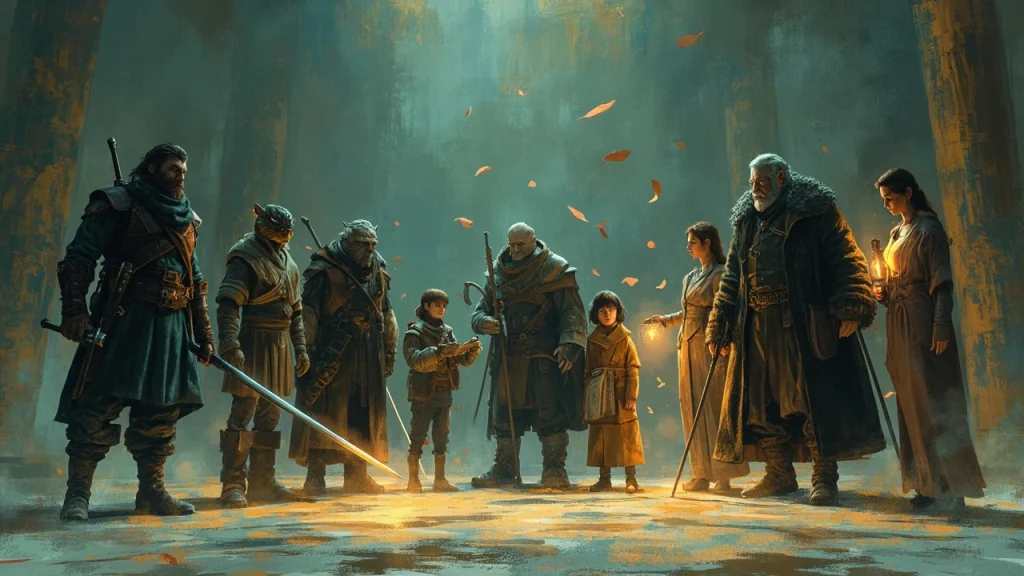
Expedition 33 characters: a developer-oriented guide to the core cast
When readers search for Expedition 33 characters, they usually want a clear map of who is in the party, what each member contributes in combat, and how the cast fits into the larger story. Clair Obscur: Expedition 33 is built around a small but distinct roster, and each character is designed around a single mechanical idea rather than a layered skill tree. That makes the cast a useful case study for turn-based combat design, role differentiation, and narrative hook construction in a mid-budget RPG.
This article focuses on the verified cast as presented in the official characters hub for the game. It treats each member as both a narrative role and a combat role, then connects those roles to the design choices that make the roster readable in the first few hours of play. Where the verified source is silent on a specific detail, the article flags the gap rather than filling it in.
The core party of Expedition 33 at a glance
The cast of Clair Obscur: Expedition 33 is intentionally compact. The story is framed around an expedition sent to confront a mysterious figure known as the Paintress, and the playable group is small enough that each member can carry a distinct combat identity without overlap. According to the verified characters overview, the primary party is built around Gustave, Lune, Maelle, Sciel, and Monoco, supported by close narrative figures such as Verso, Renoir, Esquie, and Sophie.
What makes the roster interesting from a design perspective is that each character expresses one core idea. Gustave channels engineering logic into an overcharge build. Lune channels scholarship into elemental magic. Maelle channels youth and discipline into a stance-swapping fencer. Sciel channels ritual into card-based foretelling. Monoco channels mimicry into a bestial transformation wheel. Esquie and Verso extend the roster in narrative directions rather than combat ones, which keeps the player’s mental model of “who does what” clean.
Main Expedition 33 characters and their combat identity
The following table summarizes the combat identity of each main Expedition 33 character as described in the official character hub. It is meant as a quick reference for readers comparing roles before they commit to a build or want to understand the team’s overall shape.
| Character | Narrative role | Core combat idea | Mechanical hook |
|---|---|---|---|
| Gustave | Primary protagonist, engineer tormented by the Paintress | Proficient sword-and-pistol fighter | Builds Overcharge to deal heavy damage |
| Lune | Daughter of researchers, expedition pathfinder | Archetypal spellcaster | Gains Stains to power elemental magic |
| Maelle | Youngest party member, joins despite her age | Fencer built around parries and stances | Switches Stances to change damage profile |
| Sciel | Farmer turned teacher with a traumatic past | Ritual fighter using cards | Applies Foretell stacks to make enemies more vulnerable |
| Monoco | Gestral with a deep history connected to Verso | Transformative fighter drawn to combat | Uses a Bestial Wheel to become defeated enemies |
| Esquie | Mythic creature, rumoured most powerful being | Support and traversal presence | Compassionate role supporting the party |
| Verso | Mysterious observer of the party | Non-playable narrative figure | Clouded motives, critical to the journey |
| Renoir | Primary antagonist | Opposition role | Driven to save his family at any cost |
| Sophie | Gustave’s on-and-off love interest | Narrative anchor in Lumiere | Knows Gommage is coming and what it means |
Gustave: the engineer who anchors the team
Gustave is positioned as the primary protagonist and the most mechanically straightforward member of the team. The verified character description frames him as a proficient engineer tormented by the Paintress, and his combat identity reflects that background. He relies on a sword and pistol combination, and his central resource is Overcharge, which he builds during combat to deliver heavier damage.
From a design perspective, Gustave is the “read me first” character. His toolkit rewards basic positioning and resource management, and the Overcharge mechanic gives newer players a clear build-up payoff. A few useful observations for readers evaluating his role:
- He is the most clearly ranged-and-melee hybrid in the core lineup, which makes him useful as a teaching example for stance and timing design.
- His combat loop is linear, which keeps the opening hours readable for players who have not yet learned the rest of the system’s vocabulary.
- His narrative identity as an engineer is consistent with a character whose combat kit is built around tool use rather than ritual or transformation.
For developers studying the game, Gustave is also a useful case in how to seed a protagonist’s role. His combat niche, his relationship to the Paintress, and his social role as an engineer all reinforce one identity rather than three unrelated ones.
Lune: the pathfinder and elemental spellcaster
Lune is described as the daughter of prominent researchers, the pathfinder for the expedition, and the archetypal spellcaster of the party. Mechanically, she is built around elemental magic, and her power grows as she accumulates Stains during combat. That gives her an “invest now, spend later” loop that contrasts with Gustave’s more immediate Overcharge payoff.
Lune’s design follows a few patterns worth noting:
- Her scholarly background maps to a long-form resource, which gives the spellcaster a different pacing profile from the frontline fighters.
- Her pathfinder role implies that she is the player’s wayfinding anchor in the world, even if her mechanics are not exploration tools directly.
- Stains give her a stacking dimension, which is a common way to give a mage character a visible progression curve within a single fight.
Compared to Gustave, Lune is the team’s “scale” option. Players who enjoy resource stacking and elemental coverage will gravitate toward her, while players who want a more direct damage curve will find her investment curve slower. The verified character description does not specify her elemental affinities in detail, so any deeper breakdown of her spell school would be invention rather than evidence.
Maelle: the young fencer and stance switcher
Maelle is the youngest member of the party and joins Expedition 33 despite the age gap. She does not know her real parents, which is a deliberate narrative beat that gives her character a searching quality. Mechanically, she is a fencer who excels when parrying, and her signature mechanic is switching between Stances in combat to deal different kinds of damage.
Maelle’s design is the most “rhythm” focused in the core lineup. A few useful framing points:
- Parry as a baseline skill gives her an explicit counter-play loop, which is a strong way to teach players about timing windows without forcing a dedicated tank role.
- Stance switching means her build is about reading the encounter rather than committing to one damage type, which is a useful contrast with Gustave’s committed Overcharge build.
- Her youth is a narrative counterweight to her mechanical maturity, which keeps her from feeling like a tutorial character even though she is new to the expedition.
For developers, Maelle is a good example of how to attach an advanced-feeling mechanic to a character whose story still requires onboarding. The combat kit says “I am precise,” while the narrative says “I am still becoming,” and that combination is more durable than either alone.
Sciel: the ritual fighter who plays with time
Sciel is described as a farmer turned teacher with a deeply traumatic past. Her combat identity is built around cards and a mechanic called Foretell. She uses cards in combat to apply Foretell to enemies, and each stack makes the target more vulnerable. That gives her a control-and-set-up role rather than a direct damage role.
Sciel’s design is interesting for a few reasons:
- Card-based combat is a recognizable pattern, but the Foretell framing gives it a thematic layer tied to fate and foreknowledge rather than gambling.
- Stacking vulnerability is a clean way to give a support-leaning character a visible contribution, because every stack is a number the rest of the team can plan around.
- Her farmer-to-teacher background makes her ritual feel earned, which is a useful way to integrate class identity with backstory without long expository cutscenes.
For developers, Sciel illustrates how a “soft” role can still be legible in a small party. The vulnerability mechanic is obvious to teammates, even when her personal damage output is lower than a direct fighter’s. That kind of legibility is a key design challenge in four- or five-member turn-based rosters.
Monoco: the mimic and the Bestial Wheel
Monoco is a Gestral with a deep history tied to Verso. He can speak English and, like other Gestrals, is drawn to combat. His signature mechanic is the Bestial Wheel, which lets him transform into various enemies the player encounters during the journey. That makes him a utility and discovery character rather than a single-role specialist.
A few useful notes on Monoco’s design role:
- Transformation mechanics in turn-based systems are usually read as “wildcard,” and the Bestial Wheel doubles down on that by tying Monoco’s roster to the player’s exploration progress.
- His connection to Verso gives him a narrative purpose beyond his combat role, which is important because otherwise a mimic character can feel like a gimmick.
- His draw to combat makes him thematically consistent with a character whose kit is built around the monsters of the world, which is a useful example of “lore matching kit.”
For developers, Monoco is a case study in how to integrate enemy design and party design. The Bestial Wheel effectively turns the bestiary into a second progression system, which extends content lifetime without adding new dungeons.
Verso, Renoir, Esquie, and Sophie: the supporting Expedition 33 characters
Not every Expedition 33 character in the official hub is a frontline party member. The verified character overview lists several figures whose roles are narrative rather than mechanical, and treating them as equally important gives a more honest picture of how the cast is structured.
Verso observes the party from afar, and his history is unknown. His motives are described as clouded in mystery, but his importance to the journey is described as unquestionable. Renoir serves as a primary antagonist, driven by a desire to save his family. His grizzled exterior is described as masking a deep sorrow, which is a useful reminder that antagonists in this kind of RPG are not always straightforward foils. Esquie is a strange creature, considered a myth by most, rumoured to be the most powerful being in the world, and described as compassionate beneath an intimidating frame. Sophie is Gustave’s on-and-off love interest, a headstrong woman who knows Gommage is impending and what it means for her time left alive.
A short role table helps compare these four figures side by side.
| Character | Role in story | Role in party | Key narrative idea |
|---|---|---|---|
| Verso | Mysterious observer | Non-playable | Clouded motives, unquestionable importance |
| Renoir | Primary antagonist | Opposition | Willing to do anything to save his family |
| Esquie | Mythic being | Support and presence | Compassion hidden under an intimidating frame |
| Sophie | Love interest to Gustave | Narrative anchor in Lumiere | Selfless, aware of Gommage’s cost |
How the Expedition 33 roster is structured as a design choice
Stepping back from individual members, the Expedition 33 characters form a small roster with a few deliberate design priorities. Reading the cast as a system rather than a list of biographies makes it easier to see why each role exists.
First, the team covers the standard turn-based RPG roles without redundancy. A frontline sword-and-pistoleer, a long-form spellcaster, a precision fencer, a control-oriented ritual fighter, and a wildcard mimic are five clearly separated combat identities. There is no “second tank” and no “second healer in a different costume,” which is a useful constraint to study when designing small rosters.
Second, every character has a visible mechanical hook. Overcharge, Stains, Stances, Foretell stacks, and the Bestial Wheel are all mechanics the player can see and count. That makes the team legible in combat because each character has a number or state the rest of the party can react to, which is one of the cleanest ways to keep a small party interesting.
Third, the cast uses narrative identity to reinforce mechanical identity. Gustave is an engineer, so his toolkit is built around tools. Lune is a scholar, so her toolkit is built around accumulation. Maelle is a young fencer, so her toolkit is built around precision. Sciel is a teacher with a ritual past, so her toolkit is built around cards and foresight. Monoco is a Gestral drawn to combat, so his toolkit is built around becoming other creatures. The story and the kit reinforce each other, which is a useful pattern for any narrative RPG.
Fourth, the supporting cast is built around a small number of strong narrative poles. Verso is mystery, Renoir is threat, Esquie is warmth, and Sophie is cost. None of them is asked to be a full party member, and that gives the main party room to breathe. For developers, the lesson is that a small playable roster can be extended by non-playable figures who each carry one emotional or thematic idea.
Readers looking for additional design context on the game’s combat style and how its characters fit into the wider RPG landscape can review the verified character breakdown for Clair Obscur: Expedition 33 directly, where each party member is connected to community-tested build suggestions. For a broader look at how a small party roster can shape a turn-based combat identity, the studio’s editorial on design choices that keep a small cast readable explores a similar constraint in a different genre, and the piece on how a single enemy archetype becomes a design anchor is a useful companion when thinking about how Monoco’s Bestial Wheel turns the bestiary into a progression system.
Reading the cast through the lens of party composition
Players who approach Expedition 33 as a turn-based RPG will look at the cast and ask who to bring where. The verified character hub does not provide a strict tier list, and any specific numerical ranking would be invention, but the cast does map cleanly onto a few classic party roles.
- Frontline pressure: Gustave is the obvious pick when the team needs steady, ranged-and-melee damage and a clear build-up payoff.
- Long-form scaling: Lune fits fights where stacking resources and elemental coverage pay off over multiple turns.
- Precision and counter-play: Maelle fits fights where parrying and stance switching can control an enemy’s damage profile.
- Control and setup: Sciel fits fights where stacking vulnerability on a key target gives the rest of the team a window.
- Wildcard and adaptation: Monoco fits fights where the team’s best answer is to use the enemy’s own kit against them.
That mapping is a useful frame because it explains why the cast feels distinct. Each of the five main Expedition 33 characters is built to do something the others cannot, and that non-overlap is what keeps a five-person roster from feeling thin.
What is confirmed, what is implied, and what the source does not say
The verified character hub is a starting point, not a complete encyclopedia. A few honest limits are worth stating so the article does not drift past the evidence.
- Voice actors, exact stats, and detailed skill trees are not present in the excerpt and are not invented here.
- Specific weapon stats, damage numbers, drop sources, respawn rules, and level ranges are also not in the verified source, so any claim along those lines would be guesswork.
- The ordering of story beats, who joins the party first, and the exact moment each character becomes playable are not in the verified hub, so this page treats the cast as a roster rather than a walkthrough.
- Any line about an “ultimate” version of a character, a hidden transformation, or an unannounced feature is outside the verified evidence and is intentionally omitted.
This boundary is important because the cast of Clair Obscur: Expedition 33 is designed to be discovered in play. The hub gives the reader a map of who exists and what each character does at a high level, and the rest of the game’s design assumes the player will meet each member in context.
Why the Expedition 33 character list feels like a small RPG roster done well
It is worth being explicit about why this cast works as a design object. Three structural choices stand out.
First, the team is small enough that each member can be a distinct idea. There is no filler character whose only purpose is to round out a six-slot party grid. Five playable members with one strong mechanic each is easier to balance than eight members with two mechanics each, and that choice is visible in how cleanly each kit maps to a single sentence.
Second, the cast is written around visible numbers. Overcharge, Stains, Stances, Foretell stacks, and the Bestial Wheel are all things the player can count. That is a strong design constraint because it keeps combat legible in a way that “this character has a feeling” never can.
Third, the supporting cast is small but high signal. Verso, Renoir, Esquie, and Sophie each carry one strong idea, and the game does not dilute those ideas by asking any of them to also be a playable class. That is a useful pattern for studios designing narrative RPGs with limited content budgets.
Readers who want to see the cast in motion should treat the verified character hub as the canonical reference, and the article above as a structural overview. Where the article’s framing diverges from the hub, the divergence is editorial interpretation rather than invented fact, and that is the limit a careful reader should expect.
Frequently asked questions
Who are the main playable Expedition 33 characters?
The verified character hub lists Gustave, Lune, Maelle, Sciel, and Monoco as the core party members. Each one has a distinct combat identity: Gustave as a sword-and-pistol engineer building Overcharge, Lune as a spellcaster stacking Stains, Maelle as a fencer switching Stances, Sciel as a card user stacking Foretell, and Monoco as a Gestral who uses the Bestial Wheel to transform into defeated enemies.
What kind of fighter is Gustave in Expedition 33?
Gustave is described as a proficient engineer and the primary protagonist. He fights with a sword and pistol combination and his main mechanic is Overcharge, which he builds during combat to deal heavy damage. He is the most beginner-friendly of the core cast because his loop is linear and his payoff is direct.
How does Lune play in combat?
Lune is the party’s archetypal spellcaster and uses elemental magic. Her main resource is Stains, which she accumulates during combat to power her spells. Compared to Gustave’s direct Overcharge payoff, Lune is built for a longer resource curve and gives the team elemental coverage.
What is Maelle’s combat style?
Maelle is a fencer who excels when parrying and switches between Stances in combat to change the kind of damage she deals. Her kit is the most rhythm-focused of the core cast, and it rewards players who can read enemy timing rather than commit to one damage type.
What does Sciel’s card mechanic do?
Sciel uses cards in combat to apply Foretell to her enemies, and each stack makes the target more vulnerable. She is best understood as a control and setup fighter, because her personal damage is less important than the vulnerability she stacks onto key enemies for the rest of the team.
How does Monoco’s Bestial Wheel work?
Monoco is a Gestral with a deep history connected to Verso, and he uses the Bestial Wheel to transform into various enemies the player has encountered. That makes him a wildcard and a discovery character, and it also ties the party’s progression to the player’s bestiary, which extends the value of enemy design across the whole game.
Who is Renoir in Expedition 33?
Renoir is described as a primary antagonist who is driven by a desire to save his family. The character hub frames him as willing to stop at nothing to achieve that goal, and notes that his grizzled exterior masks a deep sorrow. He is not a playable party member, but his motivation defines the expedition’s opposition.
Who is Verso and why is Verso important?
Verso is a mysterious figure who observes the party from afar. His history is described as unknown, and his motives are described as clouded in mystery, but his importance to the journey of Expedition 33 is described as unquestionable. He is one of the most discussed non-playable figures in the cast because of how much narrative weight the hub gives him despite his limited on-screen presence.
What role does Esquie play in the party?
Esquie is a strange creature considered a myth by most, and rumoured to be the most powerful being in the world. He is described as compassionate beneath an intimidating frame, and he functions as a support and presence figure rather than as a primary damage dealer. He is a useful reminder that not every supporting character needs to be a fighter.
Where can I find a verified reference for the Expedition 33 character list?
The verified reference for the cast is the official character hub for Clair Obscur: Expedition 33, which lists the core party and the supporting figures described here. It is the most reliable starting point for readers who want to confirm any specific detail before relying on it in a build guide, a discussion, or a piece of design writing.