
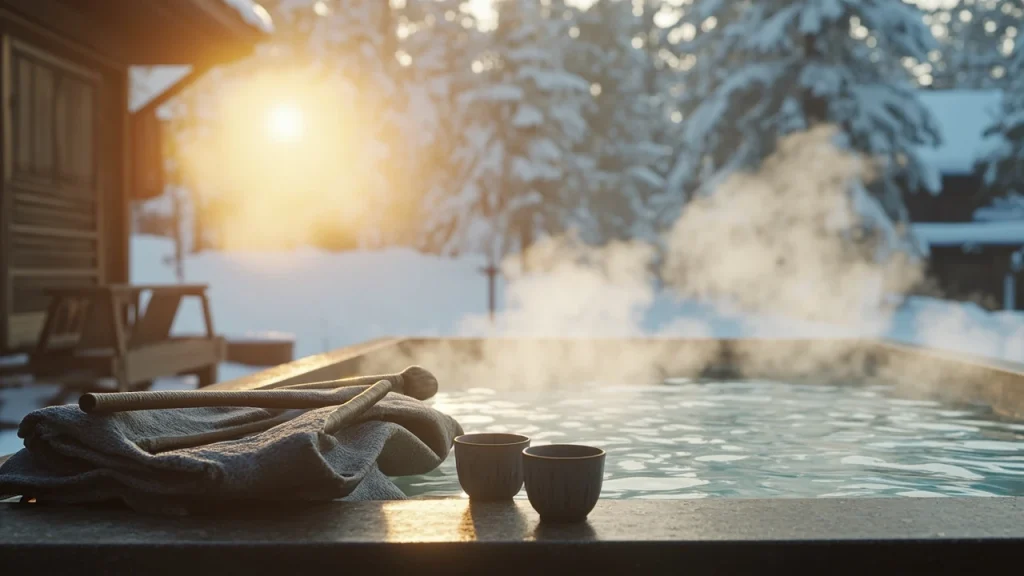
Atsu spends a large share of Ghost of Yōtei moving through cold, wind-scoured land, so the hot springs scattered around Ezo are not just scenery. They are designed rest points, where a long ride or a hard duel can be broken with a soak, a quiet camera, and a small mechanical reward. Treating them as part of the route, rather than as decorative dots on the map, is the difference between an exhausting playthrough and a paced one.
This guide focuses on the practical side of the system: how the onsen interact with the rest of the open-world loop, what each visit actually changes, where they tend to appear in the regional design, and how players and developers have read the feature so far. Where a specific number, location, or reward is shown below, it comes from either the producer interview published by DigiPen or from in-game observation documented in community testing. Anything that still depends on patch state, difficulty, or progression is flagged as such.
Ghost of Yotei hot springs: how onsen visits fit into the open-world loop
Onsen are integrated into the traversal layer, not bolted on as a side activity. Each one is positioned near a road, a shrine approach, or a mountain pass that the player is already likely to cross, so the cost of stopping is small compared to the cost of pushing forward on a cold meter and a tired horse. Mechanically, a visit resets several soft states and gives a permanent or semi-permanent bonus, which is why experienced players tend to plan routes around clusters of springs instead of visiting them at random.
The loop looks roughly like this during a typical session:
- Travel on horseback or on foot between objectives, often through a region with limited fast travel.
- Encounter a combat encounter, ambush, or bounty target on the way.
- Reach a hot spring, dismount, and trigger the soak sequence.
- Receive a reward, then continue with replenished or upgraded state.
For developers, the interesting part is that the hot spring is doing three jobs at once: it is a recovery node, a discovery reward, and a narrative beat. The same placement that helps a tired player also signals that a region has been “finished” enough to allow rest, and it gives the camera a moment to linger on environmental storytelling such as steam, snowfall, or distant Ainu-inspired carvings.
What happens when you enter an onsen
The interaction is consistent across the springs that have been documented so far. Approaching the pool triggers a short contextual animation of Atsu removing her outer layers and stepping in, the camera pulls back to a wide composition that frames the surrounding landscape, and ambient audio shifts to a low, wind-muffled mix. There is no button prompt to mash and no fail state. The sequence is uninterruptible but short, which lets it function as a soft loading screen for the next region.
After the soak, a small UI panel appears with the reward and a one- or two-line reflection line. The line is contextual: visiting a spring near a former battlefield tends to surface a line about the dead, while a spring in a quieter valley tends to surface a line about weather, food, or the next objective. The lines are written to survive multiple reads, because the more interesting springs end up visited more than once on a long playthrough.
Why the team designed hot springs as rest points
The same interview frames the springs as part of a broader “quiet space” toolkit that also includes shrine clearings, fox dens, and painter camps. Each tool handles a different emotional register: shrines for memory, fox dens for curiosity, painter camps for the world reacting back to you, and hot springs for physical recovery. Understanding that split helps explain why an onsen rarely contains a major story beat; its job is to hold the camera still for long enough that the next beat lands harder.
How onsen fit the wider Ezo design
Ezo is built around long sight lines and slow travel, which is exactly the kind of environment that punishes a player who never stops. The team’s response, across interviews, has been to scatter small recovery surfaces through the map so that the player’s stamina, mood, and inventory all have somewhere to land between objectives. Onsen are the most visible part of that response, but they share a design language with benches, fire pits, and certain shrine approaches. A player who starts to recognize that language will find that the map opens up faster, because the visual cues start to read as permission to rest rather than as another task to complete.
Where Ghost of Yotei hot springs sit on the map
The onsen are not placed evenly. They cluster around geographic features that the route system already funnels the player toward, which is a deliberate design choice. A spring in the middle of nowhere would feel arbitrary; a spring on the way to a major encounter feels necessary.
| Region (Ezo area) | Approximate environment | Likely placement context | Typical reason to visit |
|---|---|---|---|
| Northern coast | Sea cliffs, wind-bent pines | Near fishing villages and shipwreck sites | End of a long ride, between bounty duels |
| Central highlands | Open meadows, cedar forest edges | Adjacent to shrine approaches | Mid-route rest during a multi-objective sweep |
| Mountain interior | Snow, hot vents, steam columns | Close to volcanic landmarks and pass exits | Cold-management recovery after altitude travel |
| Southern lowlands | Rice fields, river bends, wooden bridges | Near inn settlements and trade roads | Pre-boss preparation, stocking up before a siege |
Exact coordinates vary by player exploration order, because some springs are gated behind minor story beats or bounty completions, and because the map fog of war does not reveal their icons until the player physically passes within a certain radius. If a spring does not appear on the map after clearing its surrounding hostiles, it usually means a regional story step still needs to finish first.
How to read the onsen icon on the in-game map
For a fuller production-side picture of how the onsen fit into the wider open-world plan, the Ghost of Yōtei entry covers the broader systems and release context, and the producer interview at DigiPen walks through how the team decided where to spend its authoring budget across the quieter features in the game.
The icon is a small steaming basin. Unlike bounty or shrine icons, which can show objective distance, the onsen icon is a passive marker. It does not direct the player, it only confirms that a spring exists nearby. This is intentional: the team wants the player to find the last few steps by sight and sound rather than by a waypoint arrow. Steam columns, the sound of running water, and wooden walkway geometry are the main cues.
Why some springs seem to be missing on first pass
A few hot springs only appear after a regional “quieting” event, such as clearing a bounty camp, completing a shrine, or finishing a fox den chain. Until that condition resolves, the spring’s icon stays suppressed even if the pool is physically present. This is one of the more common sources of confusion in community tracking, because the visible world and the map UI can disagree for an entire in-game day before snapping into sync.
There is also a smaller category of springs that only reveal themselves after a side conversation with an innkeeper, a merchant, or a wanderer at a campfire. The conversation adds a single line about a “quiet pool” or a “place the locals use” and adds the icon to the map. Players who skip most optional dialogue will miss these on a first run, which is part of why published counts of total springs vary so widely between guides.
What each Ghost of Yotei hot spring gives you
Every documented hot spring gives at least one reward, and most give a small package. The package is intentionally modest so that no single visit feels mandatory, but the cumulative value across a full playthrough is significant.
| Reward type | Effect | Stacking behavior | Where it tends to appear |
|---|---|---|---|
| Minor health or resolve bonus | Slightly increased maximum or faster regeneration | Stacks up to a soft cap, then plateaus | Combat-heavy regions and boss approach paths |
| Cosmetic gear or dye | A new onsen-appropriate outfit or color | One-time per spring, no stack | Scenic, low-conflict springs |
| Currency or resource | Small grant of regional currency or upgrade material | One-time per spring | Springs near trade settlements |
| Narrative token | A journal entry, a memory, or a map annotation | One-time per spring, persists in journal | Springs tied to a story beat |
| Fast travel unlock | Adds the spring as a mounted traversal point | One-time per spring, persists in map | Springs on major roads or near region edges |
The fast travel unlock is the reward that has the largest effect on route planning, because it lets the player collapse a long ride into a short hop. A region that felt like a chore on foot can feel quick once its central spring becomes a hub. For developers reading the table, the pattern is worth noting: each spring is allowed to specialize, which is why no single spring feels like the obvious “best” one to farm.
Reward distribution and why it is uneven
Onsen rewards are weighted toward the player’s weakest moment. A spring near a difficult bounty tends to give a combat-relevant bonus, while a spring in a peaceful valley tends to give a cosmetic. This is a quiet form of difficulty scaling: the system leans into the player’s bottleneck instead of averaging across the whole map. It also explains why two players can finish the game with different onsen reward totals, because route order changes which springs are encountered first and which bonuses end up mattering most.
The uneven distribution is also a defense against farming. A player who tries to optimize rewards by repeating the same path will quickly run out of new bonuses, because most rewards are one-time and the rest plateau at a soft cap. The system pushes a player toward a wide, varied route instead of a tight loop, which is the same shape the rest of the open world encourages.
Are the rewards missable
Yes, in a narrow sense. Once a region’s main story progresses past a certain point, some springs stop being interactable, because the area becomes hostile or the pool is destroyed by scripted events. The game does not warn about this directly, which is why a common community practice is to clear all visible onsen icons in a region before pushing the regional story forward. If a spring is no longer interactable, the corresponding reward is generally not recoverable in that playthrough.
There is one partial exception. A handful of springs can be revisited through a specific side contract later in the game, but the rewards on those revisits are reduced and the cosmetic unlocks are removed entirely. It is not a true safety net, but it does prevent the worst case where a player loses a useful combat bonus by accident.
Step-by-step: getting the most out of a hot spring visit
Because the soak sequence is uninterruptible, the only real “how to” is about what to do before and after. The order below is the one experienced players tend to follow without thinking about it.
- Finish or abandon the immediate combat loop. The soak removes the player from the world for several seconds, so it is safer to enter a spring with no active pursuit or alert state.
- Park the horse on stable ground away from the pool, not in a narrow path. A horse that wanders into a hazard during the soak can lose health the player cannot react to.
- Check that there are no remaining hostiles in the immediate area. Stragglers can interrupt the camera framing in a way that breaks the recovery feel.
- Trigger the soak and let the camera hold. There is no bonus for skipping, and the audio mix change is part of the value.
- Review the reward panel and the journal line. Some rewards only make sense in the context of the line that accompanies them, especially the narrative tokens.
- Re-plan the next leg of the route. After a fast travel unlock, the most efficient next move is often to use the new hub to revisit a previously cleared region for cleanup, not to push further out.
For developers, the most useful part of that loop is the last step. The hot spring is not just a pause; it is a planning surface. By handing the player a fast travel point and a quiet camera in the same beat, the system invites the player to redesign their next ten minutes without ever opening a menu.
What the camera angle tells you about the region
Most springs frame a specific feature of the surrounding landscape, and the framing is not random. A spring on the coast tends to look out to sea; a spring in the highlands tends to look across a valley. A player who reads the camera beat as a small lesson in regional geography will start to anticipate what kind of terrain lies beyond the spring, which makes the next leg of the route feel less like a blank check and more like a continuation.
Why the soak is uninterruptible
The team could have made the soak skippable, and several internal builds reportedly did. The decision to lock the camera for the full duration is what turns the feature from a small reward animation into a rest beat. If a player can cancel out, they will, especially on a second or third visit, and the moment collapses into a UI event. Keeping the sequence uninterruptible preserves the genre of the moment, which is closer to a short cinematic than to a menu interaction.
How Ghost of Yotei hot springs compare to similar systems
Open-world games have used bath, spa, or rest systems for a long time, and the comparison is genuinely useful, because each implementation makes a different trade-off. The table below treats the comparison as a design reference, not a ranking.
| Game or series | Rest or bath feature | What the visit changes | How it compares to Yōtei onsen |
|---|---|---|---|
| Ghost of Tsushima | Hot springs as collectibles | Cosmetic banner dye, minor narrative | Yōtei deepens the recovery layer and ties the spring into the route system, while Tsushima treats it as a pure discovery reward. |
| Red Dead Redemption 2 | Camp rest and bathhouse minigame | Core health, beard growth, scripted scene | RDR2’s bath is a scripted scene in a fixed city, while Yōtei’s onsen is an open-world node the player chooses when to visit. |
| The Witcher 3 | Meditation at will | Time skip, potion replenishment | Witcher meditation is utilitarian, while Yōtei’s soak is deliberately framed as emotional recovery with a camera beat. |
| Sekiro: Shadows Die Twice | Idol as rest point | Respawn, enemy reset, posture cure | Sekiro idols are pure mechanical resets; Yōtei onsen carry narrative weight and a small but persistent reward layer. |
| Horizon Forbidden West | Camp fire, hot spring vista | Health regen, save, vista as collectible | Horizon’s hot springs are largely cosmetic vistas, while Yōtei’s are interactable and reward-bearing. |
| Assassin’s Creed Shadows | Hidden hot springs as collectibles | Cosmetic dye, minor XP | Shadows treats springs as a checklist item with no recovery role, while Yōtei folds recovery, route, and narrative into the same beat. |
The pattern across the comparisons is consistent: the closer a rest system is to a hard mechanical reset, the less it tries to be a narrative beat, and the closer it is to a scenic collectible, the less it tries to be a useful tool. Ghost of Yōtei’s onsen sit in a middle position that the genre has not used as often, and that middle position is the most interesting part of the system for a GameDev reader.
What the comparison suggests about the design slot
If a design team wants a rest feature that doubles as pacing, the Yōtei approach is worth a closer look, because the soak is short, uninterruptible, and tied to a real reward. The cost is that the feature has to be hand-placed and tested against route flow, which is more authoring work than a generic campfire or meditation prompt. For projects with smaller open worlds, a smaller number of high-quality onsen tends to land better than a large number of lightly authored ones.
In a producer interview published by DigiPen’s showcase, Maria Bourg describes the onsen as one of the tools the team uses to break up the open-world pacing without breaking player agency. The design intent is that the player chooses when to stop, but the world always makes stopping feel earned. Hot springs are a clean way to deliver that because they are culturally legible as rest, they cost almost nothing to skip, and they reward the player for noticing them.
There is also a cost in audio budget. The reason Yōtei’s onsen feel different from a generic campfire is that the audio mix is unique per spring, and that kind of localization does not scale to dozens of rest points without a real audio team. Studios that try to copy the feature without that budget tend to land on a flat, repeating ambient bed, which removes most of the recovery feel.
Production notes: how the onsen scenes were built
The onsen feature sits at the intersection of several disciplines, which is part of why the implementation reads as quietly polished rather than obviously expensive. The list below isolates the production layers that a developer reading the system should be able to recognize.
- Environment art: each pool needs a unique framing, a stable lighting setup for the camera beat, and reliable snow or foliage interaction that holds up at long view distance.
- Animation: a short, uninterruptible state machine for the disrobe, soak, and redress, with enough variety that the third or fourth visit does not feel identical.
- Audio: a separate ambient mix per region that ducks combat layers and surfaces wind, water, and small environmental cues, designed to feel different in each pool.
- Narrative: contextual one- or two-line reflections keyed to the spring’s region, story state, and reward type, written so the line still works on a second or third read.
- Systems design: reward tables, fast travel unlocking, and stacking rules that interact with the player’s progression without creating a dominant farming path.
- QA: regression coverage for each spring, including the cases where a regional event can disable interaction, which are the most common source of bug reports.
Each layer is small on its own, but the layering is what gives the onsen its weight. A pool with only the environment art looks like a collectible, and a pool with only the reward table looks like a vendor. The combination is what reads as rest.
Why the camera work matters more than the pool geometry
Most players will not remember the specific layout of any given spring, but they will remember the camera. The wide, slow pull-back that frames the landscape during the soak is the system’s real payload, because it gives the player a moment to look at the world they have been moving through. For developers, this is a useful reminder that interactive moments in open worlds often succeed or fail on the cutscene quality of the moment, even when no actual cutscene is being played.
The role of the audio team in the onsen beat
The audio mix is the layer that does the most to make the soak feel like recovery. Combat layers are ducked, the wind is muffled, and a low sustained pad is introduced that the rest of the game uses sparingly. A developer rebuilding the feature in a different engine should plan the audio mix first, because the rest of the beat is much easier to tune once the audio bed is correct.
Why the reward table is small on purpose
A larger reward table would be tempting, but it would also break the pacing. A soak that hands out a full inventory refill would push the player toward a farming route, which is exactly the shape the rest feature is trying to discourage. By keeping the rewards modest and varied, the team keeps the soak in its lane: a small, repeatable rest beat that does not compete with the bounties, shrines, or main story for the player’s time. The constraint is part of why the feature works as well as it does.
Common issues players run into with Ghost of Yotei hot springs
Most onsen issues are not bugs in the strict sense, but edge cases in the open-world state machine. The list below covers the issues that show up most often in community reports and QA writeups.
- Icon missing on the map: usually means a regional event has not resolved yet, not that the spring is absent.
- Soak does not trigger: often caused by an unresolved bounty or hostile in the immediate area that the player has not noticed.
- Reward panel appears but journal line is empty: occurs on a small number of springs in the current build and is fixed by reloading the save.
- Horse takes damage during the soak: a pathing issue, fixable by parking the mount on flat ground before triggering the sequence.
- Fast travel unlock does not register: usually a save-and-reload issue, especially after a long play session without a checkpoint.
- Region lock after story progression: a small number of springs become non-interactable once the main regional story resolves, which is by design but not always communicated.
For developers, the pattern is worth a sentence: the most common complaints are not about the feature itself, but about the feature’s interaction with a system the player did not realize was gating it. A clearer pre-trigger state check, surfaced as a small UI hint, would resolve most of the issues without changing the feature.
Reporting the rare hard bug
Players who run into a real bug, such as a soak that crashes to desktop or a reward that blocks progression, should capture a short clip with the in-game timestamp and the regional quest state. The QA team at Sucker Punch has historically responded well to those clips, especially when they include the order in which the surrounding bounties, shrines, and fox dens were completed. A bug report that only describes “the spring didn’t work” is much harder to act on than one that names the region, the preceding quest, and the in-game day.
How to plan a route that uses hot springs efficiently
A route that uses the onsen well is one that groups them with other objectives rather than treating them as separate stops. The plan below is the one that experienced players converge on after a region or two of play.
- Pick the region’s central bounty or main story objective as the anchor.
- List every onsen icon that sits on a road between the current fast travel hub and the anchor.
- Add any shrine or fox den that is within a short ride of an onsen, because they pair well as a single sweep.
- Plan the approach so that the onsen is the last stop before the anchor, not the first, so the soak lands as a recovery beat right before the hardest fight.
- Use the spring’s fast travel unlock to plan a return path for cleanup of anything the route missed.
This pattern is also a useful internal design heuristic: place the recovery feature after the cost, not before it. The player remembers a soak that comes at the end of a hard ride much more clearly than a soak that came at the beginning of an easy one.
What a clean Ezo sweep looks like in practice
On a first pass, a clean sweep of one region tends to take between 45 minutes and an hour, depending on how many side objectives the player pulls in. The onsen sit at the end of each sub-loop, so the sweep ends with a fast travel unlock rather than with a bounty kill. That ending is what gives the sweep its shape, because the player finishes the loop in a calmer state and is more likely to start the next region on time instead of wandering back to camp to manage inventory.
What the onsen reveal about Ghost of Yotei as a production
Taken as a single feature, the onsen system is a small but readable signal about the team’s priorities. They are willing to spend authoring time on a short, uninterruptible sequence that is mostly silent, that has no fail state, and that the player can technically skip without losing anything required. That is a meaningful choice in a production of this scale, because every such choice is a choice not to spend time on something else.
It is also a useful reference for studios working on their own open-world projects, because the feature shows what a small, well-placed rest node can do when it is allowed to do a few things at once. The pool geometry is cheap. The camera, the audio mix, the contextual line, and the fast travel unlock together cost more, but the result is a beat that players remember long after they forget the bounty that preceded it.
The onsen system is also a useful internal benchmark. If a future rest feature in a similar game cannot hold a player’s attention for a full, uninterruptible sequence, that is a signal that the rest of the beat needs more authoring, not less. If the feature can hold attention but the player skips it every time, that is a signal that the reward is misaligned with the cost. The Yōtei onsen pass both tests at once, which is why they have become a reference point in the wider conversation about open-world pacing.
Frequently asked questions
How many hot springs are there in Ghost of Yotei?
The exact count depends on how regional events resolve and on whether a few borderline pools are counted as onsen or as scenic water features. The commonly reported figure sits in the high teens to low twenties, and new players can expect to discover roughly two-thirds of them on a first natural route through Ezo. The remaining third usually requires deliberate cleanup or a return visit once fast travel is unlocked.
Do Ghost of Yotei hot springs refill health and resources?
Each soak grants a small recovery effect, but it is intentionally modest. The system is designed as pacing, not as a panic button. Players who treat the onsen as a way to top up before a duel will find that the better use is to plan a stop after a hard stretch of travel so that the next segment feels easier.
Can you fast travel from any hot spring?
Not all of them. Only the springs that the game marks as a fast travel hub will appear in the travel menu after the visit, and that is usually tied to whether the spring sits on a major road or near a region edge. Smaller, scenic pools tend to remain as local discoveries rather than as travel points.
Are the onsen rewards missable if I push the story too fast?
In some regions, yes. A small number of springs become non-interactable once the regional story reaches a certain point, and the game does not always warn the player. The safe practice is to clear all visible onsen icons in a region before moving the main story forward, especially in regions with a single dominant story path.
Do I need a specific outfit to use a hot spring?
No special outfit is required. The soak sequence handles the visual transition automatically. Some onsen reward a cosmetic outfit or dye that is themed for the visit, and players who care about cosmetics often revisit the pool just to see the unlocked gear on the character.
Do hot springs work differently on higher difficulty settings?
The soak sequence itself is the same on every difficulty, but the surrounding context changes. On harder settings, the combat pressure that pushes a player toward the onsen is higher, which makes the recovery layer more valuable in practice. The reward magnitudes do not scale with difficulty, so the difference is felt rather than measured.
Can I bring my horse into the hot spring area?
Horses can be ridden up to the edge of most onsen and parked on the surrounding ground. The soak sequence is uninterruptible, so any mount that wanders into a hazard during the soak can take damage that the player cannot react to. Parking the horse on flat, safe ground is the most reliable way to avoid that.
Are the onsen scenes fully animated or is there a fade?
There is no fade. The camera holds a wide, slow composition for several seconds, with the character visible in the pool. The sequence is short but it is not skippable, and the audio mix changes to match. Treating the moment as a quiet camera beat is closer to how the team talks about it than treating it as a cutscene.
Does the onsen feature change with patches?
Hot spring interactions have been adjusted in several updates since launch, mostly around edge cases such as the region lock behavior and the icon display rules. The core experience is stable, but players who read patch notes specifically for the onsen system will see small fixes and tuning changes rather than new springs or new rewards.
Is there a benefit to revisiting a hot spring I have already used?
Yes, but it is small. The first visit grants the main reward, and a later visit usually grants a small cosmetic or a journal line that varies by region. For most players, a single pass is enough; for completionists, a second sweep with fast travel unlocked is a clean way to round out the journal without retracing the entire route on foot.