
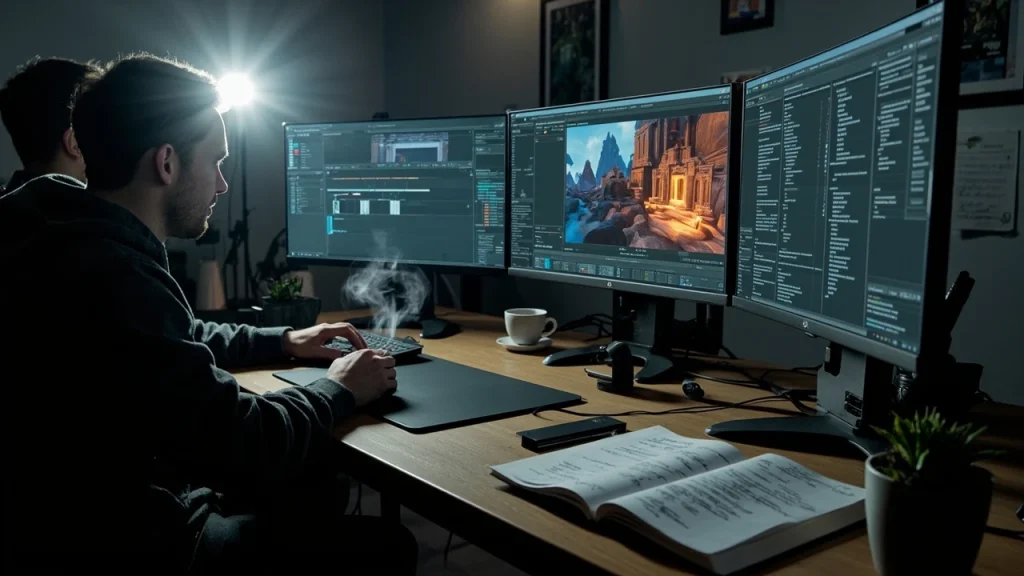
Unreal game development studio: how production teams build on UE 5
An unreal game development studio is a production team that has standardized on Epic Games’ Unreal Engine for most of its work. The choice shapes prototypes, art-to-code handoff, platform builds, cinematic budgets, and how risk is handled between vertical slice and launch. The engine rarely decides whether a game ships, but it decides which problems the team inherits and which ones the engine has already solved.
This article is for producers, technical leads, studio heads, and publishers who are evaluating or already running a UE 5 pipeline. It covers feature scope, team shape, sprint cadence, source control, build pipeline, multiplayer, cost ranges, and the trade-offs that decide whether a project stays on track. Where Epic’s documentation or shipped titles have settled on a specific approach, that approach is called out. Where the answer depends on the project, the question to ask is named.
What an unreal game development studio delivers
Unreal Engine is an end-to-end stack: gameplay code in C++ and Blueprints, a renderer with virtualized geometry, a physics solver, audio middleware, cinematics tooling, and a content pipeline that runs through a single editor. The same engine that runs gameplay also produces trailers, marketing renders, and in-engine cutscenes without re-exporting to a DCC tool, which is one reason studios pick UE 5 for cinematic projects.
The systems that most often define production scope on a new UE 5 project are listed below. Not every title uses all of them, and turning features off is a normal decision, not a compromise.
- Nanite for virtualized high-poly geometry, used on environments and hero props where the art budget benefits from dense meshes.
- Lumen for dynamic global illumination and reflections, used on indoor and reflective scenes where baked lighting would slow iteration.
- Chaos for physics and destruction, used when rigid-body and fracture behavior are part of gameplay rather than just dressing.
- MetaSounds for procedural and adaptive audio, used on projects that need layered, parameter-driven sound without a separate middleware license.
- World Partition for level streaming, used on open-world projects that need a single persistent world divided into cells.
- Gameplay Ability System (GAS) for character abilities, replication, and prediction, used on multiplayer action, RPG, and shooter projects.
- Substrate for the next-generation material system, used when projects need decoupled material expressions or production hair and eye shading.
- Movie Render Queue (MRQ) and Sequencer for cinematics, used when in-engine cutscenes and marketing renders ship from the same source assets as gameplay.
For a publisher or B2B buyer, the practical meaning is predictable production risk. Rendering, animation, physics, and audio pipelines are documented and battle-tested across published titles, so the budget can go to content and tuning rather than rebuilding the renderer.
Which projects fit a UE 5 studio
Unreal Engine 5 covers most 3D genres and a growing share of 2.5D and stylized titles. Recent shipped or in-development examples on the public UE 5 release include Manor Lords (medieval city builder), Palworld (open-world survival), Off the Grid (battle royale), Immortals of Aveum (single-player shooter), and Ark II (announced on UE 5). Older UE 4 catalog examples such as Gears 5, Sea of Thieves, and Kingdom Hearts III still inform how studios plan content pipelines for cinematic action games.
On mobile, UE 5 is realistic for mid-range and premium devices, but the feature set usually needs trimming. Many mobile teams disable Nanite and Lumen, switch to forward shading, and treat mobile as a separate scalability tier rather than a single configuration that has to work everywhere. On VR, the engine supports Meta Quest standalone targets and PCVR with sensible defaults, but performance budgets are tighter and the feature set has to be planned around frame time from day one.
The quickest way to decide whether UE 5 is the right base is to answer three questions. First, is target visual fidelity more important than the smallest possible download size? Second, are cinematics, in-engine cutscenes, or marketing renders part of the delivery scope? Third, can the team commit to C++ for performance-critical paths, or will the entire project live in Blueprints?
How a UE 5 studio is staffed
A production-ready unreal game development studio runs with specific specializations, and the cost of a project is driven by how many of those roles the team needs at each phase. The shape below reflects a typical UE 5 production team; the same roles appear at smaller scale on a vertical slice.
| Role | Primary ownership on UE 5 | Phase when load is highest |
|---|---|---|
| Unreal Engine programmer (C++) | Gameplay framework, GAS, replication, optimization | Production through launch |
| Blueprint scripter | Designer-facing logic, rapid iteration, ability scripts | Prototype and vertical slice |
| Technical artist | Materials, Substrate, MetaHuman, lighting bridging | Vertical slice through pre-launch |
| Environment artist | World Partition, Nanite-ready meshes, level assembly | Production |
| Character artist and rigger | Skeletal meshes, MetaHuman integration, animation pipelines | Vertical slice and production |
| Animator | Control Rig, sequencer animation, motion matching | Production |
| Audio designer | MetaSounds, ambient beds, mix in-engine | Production through certification |
| VFX artist | Niagara, fluid and destruction effects | Production |
| Producer | Sprint cadence, dependency mapping, milestone review | All phases |
| QA lead and engineers | Automation, soak tests, certification prep | Late production through launch |
The ratio of programmers to artists varies by genre. A stylized 2.5D title with limited gameplay code can run on a heavy art-to-code skew. A competitive multiplayer shooter on UE 5 typically carries more programmers per artist because replication, prediction, and anti-cheat interfaces add load that single-player projects do not carry.
The standard engagement model: technical review, prototype, vertical slice, production, launch
Most UE 5 projects at a studio settle into the same five-phase shape. Each phase has a gate, and the gate tells the producer whether the project is ready to spend on the next phase. Skipping a gate is one of the most common ways a UE 5 budget doubles.
- Technical review. A working session that fixes platforms, target frame rate, feature toggles, art direction, content volume, and the UE version family. The output is a written scope document that the producer and lead can defend.
- Prototype. A small build that proves the hardest technical risk: a third-person traversal loop, a multiplayer ability with replication, a destruction pass with Chaos, or a streaming stress test with World Partition. Prototype is for risk, not content.
- Vertical slice. A 5 to 15 minute slice of the game that uses the real pipeline, real art quality, and a representative slice of systems. The slice is the first deliverable the publisher or stakeholder can play, and the point at which the budget commits to production.
- Production. The longest phase, organized in 2 to 4 week sprints with weekly internal builds and regular external milestone builds. Content is built against a content matrix, not a wish list. Cinematics, marketing renders, and audio production run in parallel rather than as a post-production stage.
- Launch and live operations. Certification, store submission, day-one patch, and the start of live ops work if the project has a service component. Cooked content, patches, and DLC are all delivered through the same content pipeline as the base game.
Source control, build farm, and daily pipeline
Perforce is the default source control for UE 5 studios because the engine’s binary asset format and the size of cooked content make Git impractical for production-scale teams. Studios use Git for tooling and plugin code where it helps, and Perforce for the project repository. A UE 5 project that mixes both without a clear rule usually ends up with a long-lived branch that nobody trusts.
Build farms are the second pillar. A production unreal game development studio runs automated nightly cooks per target platform, so QA starts every morning with a fresh build. The build farm is also where MRQ cinematic renders and lighting bakes run on a queue, freeing artists’ local machines for content work. Two decisions matter early:
- Where the build farm lives. Cloud-hosted Windows and Linux build agents scale with the project; on-premises hardware is faster per minute but caps at a fixed number of concurrent cooks.
- What the build farm cooks. The minimum useful set is editor PIE smoke tests, the Win64 client, and the console target. PS5 and Xbox Series builds usually run on licensed hardware modules and need a separate access model.
For studios that want a sanity check on pipeline decisions before any content budget is committed, an established studio’s overview of Unreal Engine production trade-offs is worth reading alongside Epic’s own documentation.
Multiplayer: where an unreal game development studio spends extra
Multiplayer is the single biggest driver of cost variance on UE 5 projects after visual fidelity. The reason is structural: every system that ships in single-player has a second implementation in multiplayer, and that second implementation is the one that decides whether the game is playable on launch day.
| System | Single-player cost | Multiplayer cost on UE 5 | Why it costs more |
|---|---|---|---|
| Character abilities | Local actor logic | GAS with replication, prediction, and rollback hooks | Server authority, ability prediction, and reconciliation across client and server state |
| Physics | Local Chaos simulation | Server-authoritative rigid body with replicated snapshots | Client cheating, desync, and physics determinism |
| Inventory and persistence | Local save file | Backend service plus replicated cache | Session restore, anti-cheat, and cross-session inventory |
| AI | Local behavior tree | Server-driven AI with replicated transforms | Server load, replication bandwidth, and snapshot culling |
| Audio | Local MetaSounds | Replicated cues plus proximity with bandwidth budget | Voice chat, music transitions, and per-client mix |
The list is not a reason to avoid multiplayer. It is a reason to write the multiplayer plan into the technical review, not the production phase. A vertical slice that does not include the multiplayer architecture usually forces a rewrite at the worst possible moment.
Cost ranges and what actually moves the number
Cost depends on scope more than engine. The figures below are drawn from a representative UE 5 production shape and are useful as a sanity check, not a quote.
- A vertical slice on UE 5.6 with a small team typically starts around €80,000 and runs 3 to 4 months.
- A full commercial single-player title on UE 5 with cinematics, MRQ renders, and a content pipeline can range from €250,000 to €1,000,000 and take 12 to 24 months from prototype to launch.
- A multiplayer action or shooter on UE 5 with server authority, GAS, and a live-ops backend ranges from €500,000 to €1,500,000 or more, and adds 3 to 6 months of QA and certification before launch.
Two variables move the number most. Rendering fidelity drives art headcount and iteration time on lighting, environments, and characters. Multiplayer scope drives backend cost, QA load, and the schedule buffer that certification requires. Cinematic work is a third variable that scales with how many sequences, MRQ passes, and marketing renders the project is expected to produce, and it is the one most often underestimated at the technical review.
UE 5 version strategy on a live project
Most new commercial projects start on UE 5.6, the current release family. UE 5.4 and 5.5 are still in production for live games, and UE 4.27 is maintained mainly for ports and legacy titles. The choice of version is a feature decision and a maintenance decision at the same time: it affects how long the studio can ship patches, how platform holders receive the build, and how the studio handles deprecations.
The safest rule for a new project is to commit to a single minor version family and to track Epic’s release notes for the patch line. Jumping minor versions mid-production is a documented source of regressions, especially in rendering and replication. When a project has to upgrade, the upgrade belongs at the start of a milestone, not the week before a publisher build.
Working with an outside unreal game development studio
Studios that need additional capacity typically work with outside teams in one of three engagement models. The right model depends on what the in-house team already has.
- Full-cycle game development. The outside studio owns the production from technical review through launch, with a producer and a lead of each discipline embedded with the client team.
- Co-development. The outside studio takes ownership of specific systems or content streams, with a shared sprint cadence and a shared build pipeline. This works well when the in-house team owns the vision but needs additional capacity on art, multiplayer, or cinematics.
- Team extension. The outside studio adds individual engineers, artists, or technical artists to the in-house team, working under the in-house lead. This is the right model when the in-house studio already has the architecture and the producer, and needs specialized capacity without adding full-time headcount.
The right model is set by the technical review, not by the procurement conversation. A team that has never shipped on UE 5 should not start a co-development engagement without a producer who has. A team that already has the architecture should not hand full-cycle ownership to an outside studio for the convenience of a single contract.
How to validate the studio before signing
Validation is the most predictable way to control cost on a UE 5 project. The checks below are useful for any team, in-house or outside, that has not shipped a comparable title on UE 5.
- Ask for a representative slice of a shipped title, not a marketing reel, and walk the scene in the editor while it runs.
- Ask which UE version family the shipped title used, and whether the studio has shipped on the current release family.
- Ask what the build farm looks like, how many concurrent cooks it runs, and what the average cook time is on a representative content set.
- Ask who owns replication on multiplayer projects, and how the studio handles rollback, prediction, and anti-cheat interfaces.
- Ask what the sprint cadence and weekly build cadence look like, and what the last three milestones actually shipped on the planned date.
- Ask for a recent postmortem, written by the studio’s own producer, on a project that went off track. The honesty of the postmortem is a stronger signal than any reel.
Common mistakes when an unreal game development studio scales
The mistakes below are not unique to UE 5, but they show up at predictable moments on UE 5 projects and cost more because the engine’s feature set raises the bar for what counts as acceptable quality.
- Treating the vertical slice as a demo. The slice is the first delivery on the production budget, not a marketing artifact. The moment the slice becomes a demo, the production plan loses its anchor.
- Letting art lead without a technical art bridge. Nanite, Lumen, and Substrate look spectacular on a single art test and break on a real content set without a technical artist watching the cost.
- Skipping the multiplayer plan. Replication, prediction, and authority are architecture, not features. They belong in the prototype, not the production phase.
- Letting cinematic work wait until production ends. Sequencer and MRQ scale with the project. A cinematic team that joins in the last six months can derail a launch.
- Cooking content per platform by hand. A build farm that runs nightly cooks is a small cost against the cost of a missed certification window because the team was still cooking the day before submission.
Where an unreal game development studio adds the most value
The engine does the heavy lifting on rendering, animation, physics, and audio. The value a studio brings is on the systems around the engine: a producer who can defend a scope, a technical artist who can keep Nanite and Lumen under budget, a programmer who can build a replication-safe ability system, and a build engineer who can keep the daily cook running. The engine is the reason the project is possible. The studio is the reason the project ships.
Frequently asked questions
What does an unreal game development studio actually do?
An unreal game development studio plans, builds, and ships games on Unreal Engine, with a team that includes programmers, technical artists, environment and character artists, animators, audio designers, VFX artists, producers, and QA. The studio owns the production pipeline, including source control, build farm, sprint cadence, and certification, and is responsible for delivering a build that meets the agreed scope on the agreed platform targets.
Which Unreal Engine version should a new project use?
Most new commercial projects start on UE 5.6, the current release family. Projects with a longer production horizon can also plan around UE 5.5, but a project should not jump minor versions mid-production without budgeting the upgrade as a milestone. UE 4.27 is maintained mainly for legacy titles and ports.
How much does it cost to ship a game with an unreal game development studio?
Cost depends on scope. A vertical slice on UE 5.6 with a small team typically starts around €80,000. A full commercial single-player title with cinematics and a content pipeline ranges from €250,000 to €1,000,000. A multiplayer title with server authority and a live-ops backend ranges from €500,000 to €1,500,000 or more. Rendering fidelity and multiplayer scope are the two variables that move the number most.
When is Unreal Engine the wrong choice?
UE 5 is the wrong choice when the project is a small 2D mobile title with no need for cinematic or high-fidelity rendering, when the team is unwilling to use C++ for performance-critical paths, or when the smallest possible download size is a hard requirement. For those projects, a 2D-focused engine is usually a better fit.
What is the difference between a co-development engagement and a team extension?
Co-development means the outside studio owns specific systems or content streams under a shared sprint cadence and a shared build pipeline. Team extension means the outside studio adds individual engineers or artists to the in-house team, working under the in-house lead. Co-development suits a team that has the vision and needs capacity; team extension suits a team that has the architecture and needs specialized skills.
How does an unreal game development studio handle multiplayer?
Multiplayer on UE 5 uses server authority, the Gameplay Ability System for abilities with prediction and rollback, and replicated transforms for AI and physics. The architecture is decided in the prototype, not in production, and the studio owns the replication plan, the anti-cheat interface, and the backend integration with the chosen game services platform.
Do UE 5 projects need a dedicated build farm?
Yes, on any project larger than a vertical slice. The build farm runs nightly cooks per platform, MRQ cinematic renders, and lighting bakes. A studio that tries to cook on artists’ local machines usually ends up with missed certification windows and unstable weekly builds.
What is the role of a technical artist in an unreal game development studio?
The technical artist is the bridge between art and engineering. On UE 5, this role owns material graphs, Substrate, lighting bridging, MetaHuman integration, and the cost of Nanite and Lumen on real content. The technical artist is the reason the art direction can be defended against the rendering budget without losing quality.
Can an unreal game development studio ship a mobile title on UE 5?
Yes, on mid-range and premium devices. The trade-off is that Nanite, Lumen, and Substrate are usually disabled on mobile, forward shading replaces deferred shading, and the scalability tiers are planned from the technical review rather than retrofitted. A mobile title on UE 5 is realistic, but the feature scope has to be planned around the device tier.
How do I know whether a studio can ship my project on UE 5?
Ask for a representative slice of a shipped UE 5 title, walk the scene in the editor, and ask for a recent postmortem. The honesty of the postmortem is a stronger signal than any reel. A studio that can defend its last three milestones and its version family is a studio that can defend yours.