
What is a triple A game?
A triple A game, usually written as “AAA game” or “3A game,” is a video game produced with the largest budgets, the biggest internal teams, and the widest marketing push that a publisher can mount. The label is industry shorthand for projects that sit at the top of the commercial scale: full-scale development studios, several hundred people, multi-year timelines, and release campaigns that span global media buys, festival presence, and platform partnerships. The phrase borrows the letter-grade idea from bond credit ratings and applies it to game production, where “A” budgets and “A” efforts are understood across the industry to mean a flagship project rather than a side bet.
For a working developer, the term is less about a fixed checklist and more about a recognizable cluster of attributes. A triple A project usually has a dedicated publisher funding it, a roster of specialists rather than generalists, milestone-driven production, formal external QA, certification on console platforms, and a launch window anchored to a fiscal calendar. It is also, by definition, a bet at scale: the kind of release whose success or failure is reported on quarterly earnings calls. Understanding what is a triple A game means understanding how production, budget, team, and distribution all converge in one category of release.
This article unpacks that definition from the production side. It looks at how studios actually plan, staff, and ship a triple A game, where the label breaks down, and how AAA compares with the adjacent categories of AA and indie production. The goal is to give developers, producers, students, and curious players a clear picture of what the label means in real workflow terms rather than only in marketing copy.
Where the term “triple A” comes from in game production
The “triple A” label migrated into games from finance. Credit rating agencies have long used letter grades to communicate risk, and “AAA” sits at the top of that scale. Publishers and trade press adopted the same idea during the 1990s console era, when projects such as Final Fantasy VII on PlayStation 1, GoldenEye 007 on Nintendo 64, and Half-Life on PC signaled a new tier of investment and ambition. By the early 2000s, “AAA” had become a standard way to describe a flagship release rather than a small or experimental project.
It is worth flagging that the term is not regulated and has no single governing body. “AAA” is a working description, not a certification. Two projects in the same fiscal year at different studios can both be called AAA even when their budgets, team sizes, and production realities differ significantly. This is one reason the term is often used loosely in player conversations and more carefully in production planning, where the actual numbers tend to anchor the conversation.
The label is also distinct from the unrelated baseball championship. For additional context, The Triple-A National Championship Game is a single postseason baseball game contested between the International League and Pacific Coast League champions, and uses “Triple-A” to denote the highest level of Minor League Baseball. The video game term has the same letter idea but a different origin, and a quick search of the phrase will surface both meanings.
Core attributes that define a triple A game
Although there is no formal spec, the working definition of a triple A game rests on several attributes that consistently appear together in industry reporting, postmortems, and production planning. The list below captures the attributes that show up most often in trade coverage, studio postmortems, and developer interviews.
- Large development budget, typically reported in the tens of millions of US dollars, and in many cases substantially more for major franchise entries.
- Large internal team, often several hundred people including programmers, designers, artists, animators, audio, QA, producers, and support staff, sometimes supplemented by outsourcing partners.
- Multi-year production cycle, generally three to five years for a flagship release, with longer pre-production for new intellectual property.
- Publisher funding and oversight, where the publisher provides the capital, handles platform relationships, and often owns or controls the intellectual property.
- Marketing and distribution at scale, with global campaigns, paid media, festival presence, and platform holder partnerships.
- Console certification and platform launch, with formal submission to platform holders such as Sony, Microsoft, and Nintendo, and certification testing on each target platform.
- Full-feature scope at launch, meaning a complete campaign or core experience is expected to ship on day one rather than as an early access build.
- Live operations or post-launch content in many cases, particularly for online or service-based releases, with planned seasons, expansions, or ongoing updates.
None of these attributes is a hard line. A game can be lower-budget and still be marketed as AAA, and a high-budget game can fail to land the marketing and distribution profile that the label implies. The attributes work together, and the category is recognizable when most of them are present at once.
How budgets and team size actually shape a AAA project
Budgets for a triple A game are the most discussed and least standardized number in the industry. Studios and publishers rarely publish full production budgets, so most figures come from leaked internal documents, court filings, and reporting on cancelled projects. Even those numbers should be read carefully, because they may include marketing, platform fees, and amortization of engine or technology work that the studio will reuse on future projects.
For a working definition, the ranges below are useful as orientation rather than as hard thresholds. They reflect the rough scale seen in trade coverage and postmortems over the past decade and should be treated as approximate, since each project’s actual numbers depend on genre, scope, and platform count.
| Project type | Reported budget range (USD) | Typical team size | Common development cycle |
|---|---|---|---|
| Mid-tier AAA (single-platform, established franchise) | ~30–80 million total | ~150–300 people | ~2.5–4 years |
| Flagship AAA (multi-platform, new IP or major sequel) | ~80–200 million total | ~300–600 people | ~3–5 years |
| Premium service AAA (online, live operations) | ~100–300 million+ total | ~400–1,000+ people | ~3–6 years, with ongoing live team |
Team size drives a great deal of the cost. A 400-person team paid a fully loaded average of roughly 150,000 US dollars per year, working for four years, reaches a headcount cost in the 200 million range before marketing. Marketing itself is often reported at roughly half of the development budget for the largest releases, and platform licensing, certification, and localization add further overhead. The result is that a high-end AAA release can cost more to launch than a mid-budget feature film, which is part of why the financial risk is treated as a board-level concern at major publishers.
It is also important to note that team size does not scale linearly with output. Communication overhead, integration risk, and review cycles grow with headcount, which is why larger teams invest heavily in production management, technical direction, and content pipelines that smaller projects can skip or run more informally.
The production structure of a triple A game
A For additional context, triple A project is run as a formal production, not a creative sprint. Studios structure the work into phases, milestones, and review gates so that a project of that scale remains coherent over several years. The table below outlines the phases most studios use, with the caveat that every studio has its own internal vocabulary and the lines between phases are often blurred in practice.
| Phase | Primary goal | Typical outputs | Team focus |
|---|---|---|---|
| Concept and pitch | Validate the idea, audience, and rough cost | Pitch document, prototype, target platform list | Small leadership team, design director, producer, key leads |
| Pre-production | Lock the design, technology, and pipeline | Vertical slice, art direction, technical design document, schedule | Core team across disciplines, prototype engineers, lead artists |
| Production | Build the full content and systems | Feature-complete builds, internal milestones, content drops | Full team, with QA, audio, animation, and outsourcing ramping up |
| Alpha | Lock features, focus on stability and content completion | Feature-complete internal build, initial certification prep | QA integrated, bug fixing prioritized, scope freeze |
| Beta | Polish, performance, certification readiness | Candidate builds, certification submissions, marketing assets | QA lead role, certification engineer, performance optimization |
| Release and launch | Ship across all target platforms | Master build, day-one patch, launch trailer, store presence | Live operations team takes over for online titles |
| Post-launch support | Maintain stability, deliver content, plan sequels or expansions | Patches, DLC, seasons, and live events | Live operations, community, analytics, ongoing content |
Each phase has a clear decision the work is trying to enable. The vertical slice in pre-production is meant to answer “can we make this and what will it actually look like.” Alpha is meant to answer “is the content complete and stable enough to lock features.” Beta is meant to answer “is the build ready to certify and ship on every target platform.” These gates exist because, at AAA scale, decisions made without a working build become too expensive to reverse.
What AAA production looks like for different disciplines
Understanding what is a triple a game also means understanding how each discipline works within that structure. The list below summarizes how the most common disciplines function inside a AAA project, with the caveat that titles and reporting lines vary between studios.
- Programming. Engine programmers, gameplay programmers, tools programmers, network and backend programmers, and platform engineers typically sit in separate groups, each with a lead and a technical director above them.
- Design. A design director oversees systems, level, encounter, narrative, and UX designers, each owning a slice of the player experience. Design at AAA scale is often more about reviewing, integrating, and balancing than authoring individual features.
- Art. Concept, character, environment, prop, and tech art are usually separate groups. A large AAA project may have several hundred artists split across these groups, plus outsourcing coordinators and art producers.
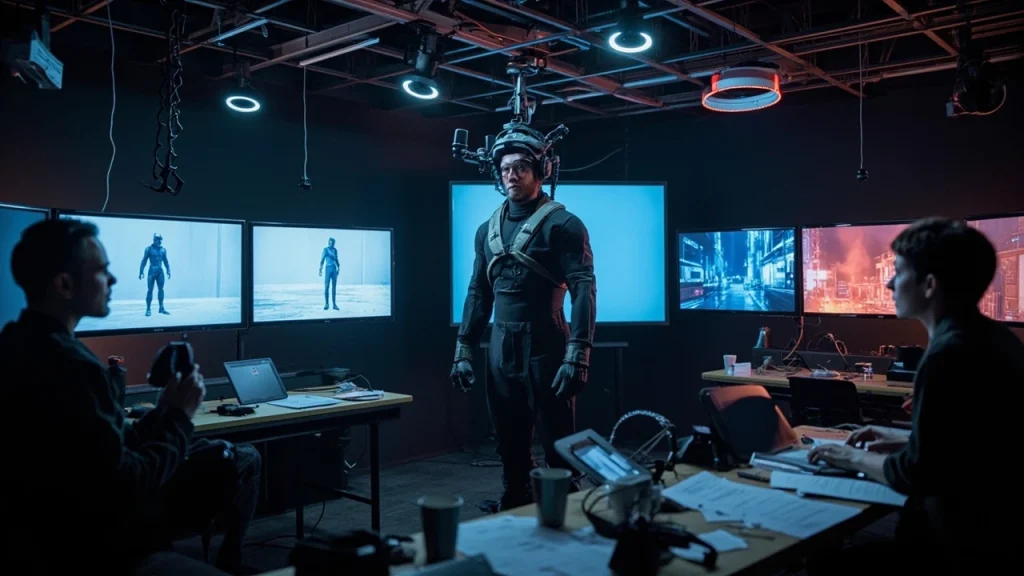
- Animation and motion capture. Dedicated mocap stages, animators, and riggers handle the volume of animation a flagship project requires. Cinematic work often lives in a separate sub-team.
- Audio. Dialogue editing, sound design, music composition, and mix engineering are handled by specialists, often with external composers and recording sessions for major releases.
- Quality assurance. Internal QA grows substantially through production and dominates the headcount during alpha and beta. Test plans, regression suites, and certification prep are the core of the work.
- Production and project management. Producers, project managers, and production coordinators own schedules, dependencies, and communication between disciplines. At AAA scale this is a full-time discipline, not a side role.
- Live operations. For online titles, a separate live ops team takes over after launch, with its own producers, analysts, and content cadence.
This division of labor is one of the clearest ways to recognize a AAA project from the outside. A team of 30 can ship a creative, well-reviewed game, and a team of 500 can ship a mediocre one. What the larger team buys is parallelization: more content, more platforms, more polish passes, and the ability to ship a complete experience on day one across several platforms.
AAA vs AA vs indie: how the categories actually differ
Alongside AAA, the industry uses two adjacent categories that often come up in the same conversation: AA, sometimes written as “double-A” or “2A,” and indie. The lines are not sharp, but the differences are real and worth understanding for anyone comparing project types or planning a career move.
| Attribute | AAA | AA | Indie |
|---|---|---|---|
| Budget scale | Reported in tens to hundreds of millions of USD | Often in the low tens of millions or less | Ranges from a few thousand to a few million USD |
| Team size | Hundreds of people, multi-discipline | Typically dozens, with some specialist hires | Often fewer than twenty, sometimes solo |
| Publisher role | Often publisher-funded and owned | May be self-funded, partially funded, or co-published | Frequently self-funded, sometimes with a publishing partner |
| Marketing scale | Global campaigns, paid media, festival presence | Targeted campaigns, often digital-first | Community-driven, festivals, organic coverage |
| Risk profile | High financial exposure per title | Moderate exposure, often portfolio-based | Lower absolute exposure, high variance per studio |
| Production structure | Formal phases, milestone gates, dedicated production discipline | Phased but leaner, fewer specialists | Often fluid roles, prototype-to-release cycles |
AA is sometimes described as “AAA ambition, smaller budget.” Studios that make AA projects often target a familiar genre with high production values, accept a smaller scope, and use leaner teams. Indie covers a wide range, from solo developer experiments to studios of 20 or 30 people shipping on every platform. The categories overlap at the edges, and a successful indie studio can grow into AA or even AAA scope over multiple projects, just as a studio can scale down from AAA to a more sustainable production model.
How to recognize a AAA release from the outside
Players, journalists, and aspiring developers often want a quick way to identify whether a release sits in the AAA category without seeing the production budget. The list below is a practical heuristic, not a definition, but the signals are consistent across the industry.
- Publisher footprint. The release is published by a major publisher or by a publisher-owned studio, with platform-level marketing support.
- Multi-platform release. The game ships on more than one major platform on day one, often with platform-specific certification.
- Full price at launch. The standard edition is priced at the platform’s premium tier, with collector’s or special editions above that.
- Press preview and review events. The publisher runs an early review cycle with preview builds, hands-on events, and coordinated review embargo.
- Marketing presence at major shows. The release is featured at E3, Gamescom, Tokyo Game Show, Summer Game Fest, or equivalent global events.
- Massive credits roll. The end credits list several hundred or more contributors, often split across multiple internal and external studios.
- Post-launch roadmap. A roadmap of patches, DLC, or live content is announced before or at launch.
None of these is sufficient on its own, and any one of them can be present on a non-AAA project. Together they form a recognizable pattern, which is how the label actually works in industry conversation.
Common misconceptions about AAA games
Because “AAA” is used loosely in marketing and player communities, several misconceptions have stuck. Clearing them up helps frame what the label does and does not mean.
- AAA does not mean high quality. A AAA budget buys scope, polish, and reach, not a guarantee of design quality. Several high-budget releases have launched to poor reviews, and several small-budget releases have launched to critical acclaim.
- AAA does not mean one studio. A typical AAA release involves internal teams, outsourcing partners, and support studios across several countries. The published credits are usually longer than a small feature film.
- AAA does not mean single-player. The category includes live service titles, competitive multiplayer games, and online platforms. The scale of investment, not the genre, defines the label.
- AAA does not mean no bugs. Certification testing and internal QA are extensive, but a release of that scope still ships with known issues, which is why day-one patches are now standard for many flagship titles.
- AAA does not mean unlimited budget. Even the largest projects run against a fixed budget, with trade-offs between scope, schedule, and quality throughout the production cycle.
The misconceptions usually come from treating the marketing line as the production reality. A more useful mental model is to read “AAA” as “a flagship commercial project funded and shipped at the top of the industry’s scale,” and to evaluate each release on its actual production choices.
How AAA production is changing in the current generation
Several pressures are reshaping what a triple A game looks like in 2026. The list below is not exhaustive, but each item is a real force that production leads factor into planning and that working developers are likely to encounter in job descriptions, postmortems, and studio announcements.
- Live operations is becoming the default for online titles. More publishers structure AAA releases as platforms with seasons, battle passes, and ongoing content, which changes the post-launch team and the revenue model.
- Generative tooling is integrated into content pipelines. Studios are adopting generative tools for concept art, audio, and code assistance under internal review, with human authorship and validation steps still required for shippable content.
- Cross-platform development is now standard. Shipping on PC, current-generation consoles, and cloud platforms in parallel is treated as a baseline expectation, not a stretch goal.
- Engine choice is increasingly strategic. Studios weigh the cost of building proprietary engines against the cost of licensing a commercial engine, and middleware choices affect both budget and headcount planning.
- Workforce conditions are a production constraint. Higher expectations around crunch, remote work, and unionization are reshaping how studios plan schedules, headcount, and milestones, and are increasingly part of the public conversation about AAA development.
- Player expectations on accessibility have risen. Platform holders, players, and press now expect baseline accessibility features such as remappable controls, subtitle options, and difficulty settings, and those features are scoped in early in pre-production.
These shifts do not change what a triple A game is at its core, but they change how a studio plans, staffs, and ships one. A useful working definition of AAA in 2026 needs to leave room for the live service model, the cross-platform expectation, and the production realities of distributed teams.
How to apply this understanding as a developer or producer
For someone working in or entering the industry, the practical value of understanding what is a triple a game is in the planning decisions it shapes. A few honest points are worth making directly.
- AAA is a production category, not a creative ranking. Career decisions based on creative interest should look at the project, the studio, and the team, not the AAA label alone.
- Specialization becomes a survival skill at scale. A 500-person project cannot run on generalists, so the long-term value of deep expertise in a single discipline is high.
- Communication overhead grows with team size. Understanding how to write clear design documents, run review meetings, and own a feature end to end is part of what makes a developer effective at AAA scale.
- Project realities are visible in job descriptions. Reading AAA job postings, with their attention to specific engine version, platform, and pipeline tooling, is a useful way to understand what a studio is actually building.
- Indie and AA experience is highly relevant. A strong AA or indie background transfers well into AAA roles, because the underlying craft, code quality, and design thinking are the same, even when the production structure is different.
The label is most useful when it is treated as a description of a production reality rather than a quality mark or a target to chase. Once it is read that way, it stops being a piece of marketing and starts being a useful way to plan, compare, and talk about projects.
Frequently asked questions
What is a triple A game in simple terms?
A triple A game is a video game produced with a top-tier budget, a large development team, a multi-year timeline, and a major publisher’s marketing and distribution support. The label signals flagship commercial production, not a guaranteed quality level. Budgets commonly reach tens of millions of US dollars or more, and teams can run into the hundreds of contributors.
What does the “AAA” in triple A actually stand for?
The “AAA” comes from the credit rating convention used in finance, where a triple-A rating signals the lowest risk and the highest reliability. Game publishers adopted the same idea in the 1990s to describe flagship projects at the top of the industry’s commercial scale, and the usage has stuck since.
How is a AAA game different from an AA game?
AA games, sometimes called “double-A,” are typically produced with smaller budgets, smaller teams, and shorter timelines than AAA, while still aiming for high production values and a broad release. Many AA releases focus on a familiar genre with tight scope, while AAA releases often target multiple platforms, larger worlds, and more ambitious content volume.
Are all big-budget games considered triple A?
Most large-budget releases are described as AAA, but the label is informal and depends on the production context. A big-budget mobile release, a large free-to-play live service, and a single-player console flagship can all be called AAA, but their production structures, revenue models, and team sizes differ. The label is most useful when it captures the combination of budget, team, and distribution rather than any single attribute.
How long does it take to make a triple A game?
Most triple A releases take three to five years from pre-production to launch, with longer cycles for new intellectual property and shorter cycles for established franchise entries. Live service titles often have a longer effective horizon because the post-launch live operations team continues work for several additional years.
How many people work on a triple A game?
Team size varies widely. A mid-tier AAA project might involve 150 to 300 people at peak, while a flagship or live service release can involve 400 to over 1,000 contributors when internal staff, outsourcing partners, and support studios are counted. The published credits at the end of a AAA release typically list several hundred or more names.
Do AAA games always launch on multiple platforms?
Most AAA releases target more than one platform on day one, including combinations of PC, current-generation consoles, and cloud services. Single-platform AAA releases do exist, often tied to a platform holder’s strategy or a franchise historically associated with one platform, but multi-platform launch is the more common pattern for current-generation flagships.
Is “triple A” the same as the baseball “Triple-A”?
No, the two uses of “Triple-A” are unrelated. In baseball, Triple-A refers to the highest level of Minor League Baseball, and the Triple-A National Championship Game is a postseason game between the International League and Pacific Coast League champions. In games, “AAA” describes a flagship production tier, and the two phrases are sometimes confused because they share the same letter idea.
Are mobile games ever considered triple A?
Several high-budget mobile releases are described as AAA, particularly when the development team, marketing spend, and revenue profile match the scale expected of a flagship project. The category is most often used for console and PC releases, but it can apply to any platform where a project reaches top-tier production scale.
Will AAA development keep growing in scale?
Budgets have risen over the past two console generations, but several studios are publicly recalibrating toward leaner productions in response to the financial risk of large-scale releases. Live service models, generative tooling, and engine reuse are all shaping how studios plan, so the next phase of AAA development is more likely to focus on sustainable scale and pipeline efficiency than on a continuous rise in headcount or budget.